Monorepo Onboarding Strategies That Scale With Codebase Complexity
Structure and code intelligence help new engineers navigate complex monorepos independently.
Engineering onboarding in a large monorepo works better when contributors can find the code they need, trace dependencies, and know who owns it without waiting for an expert. The strategies that make this possible are consistent structure, searchable code intelligence, and controlled access to current codebase knowledge. These must scale with the repository’s complexity because onboarding primarily depends on access to code context.
Why monorepos create a code context problem, not just a tooling problem
Cognitive load is the first obstacle for someone entering a monorepo. A single repository can contain dozens or hundreds of projects, libraries, and services, yet seeing those files does not explain how the software behaves. New engineers lack the organization-wide context that experienced contributors use to judge where a change belongs and what it might affect. AI coding agents lack the same context, though they act differently when it is missing.
This makes code understanding a separate concern from CI configuration or package management. A build tool can resolve declared dependencies without explaining the ownership boundaries or team conventions that a contributor needs to follow. Monorepos make the cost of ignoring those relationships immediate and visible, which creates pressure for strong engineering hygiene. But that hygiene also has to be learned, and newcomers carry the heaviest learning burden.
How codebase complexity compounds as a monorepo scales
The burden grows with both the number of files and the relationships between them. Adding a package adds a node to the dependency graph, but it can also add edges to existing packages that share a concern. Understanding the package being edited is no longer enough to understand the change.
Ownership becomes harder to infer for the same reason. When contributors can modify code across team boundaries, responsibility needs an explicit representation rather than an assumption about who usually works there. Otherwise, contributors have to ask a senior engineer who owns the code. Documentation adds a second source of uncertainty when the codebase changes faster than its descriptions.
Google’s monorepo shows how far this growth can go. With over two billion lines of code, tens of thousands of developers, and tens of thousands of commits per day, it required custom version control infrastructure, Piper, and a custom build tool, Blaze, open-sourced as Bazel. The lesson from Google’s infrastructure is that ownership, boundaries, and discoverable conventions must become explicit before maintaining an informal understanding of the repository becomes the team’s primary work.
Structural patterns that make a large monorepo navigable from day one
With a consistent internal structure, a new engineer can better predict where code belongs. When every application is organized differently, finding one feature teaches little about finding the next. Architecture scaffolding reduces that repeated orientation work, while short, concrete documentation explains how to add a feature. Together, they leave more attention available for understanding the logic itself.
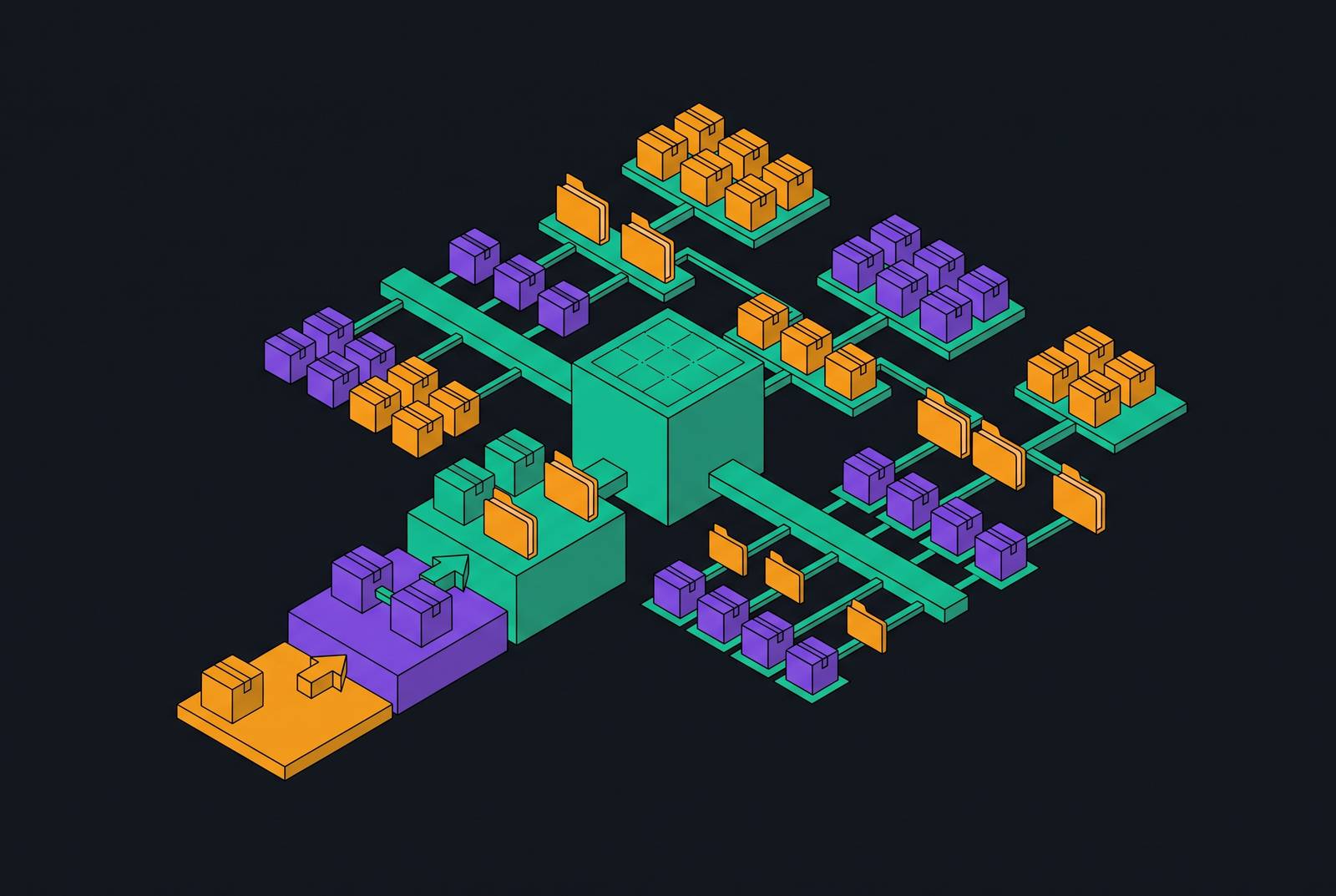
However, folders alone are not an adequate model of a monorepo. The more useful model consists of nodes and edges, where apps and libraries are nodes and dependencies connect them. A simple dependency diagram can show which packages import which others and which imports are prohibited. Public APIs, module boundaries, and ownership assignments then turn the diagram into rules for making changes.
Those rules become more useful when the repository enforces them. Lint rules and build-time checks can block cross-boundary imports so every newcomer does not have to remember an architecture document. Bazel supports declarative dependency graph resolution suited to polyglot enterprise codebases, while Nx and Turborepo provide affected-package detection optimized for JavaScript/TypeScript. These tools meet different needs for enforcement and orchestration, and they still need a clear structure to work with. CODEOWNERS files or other forms of ownership enforcement show who is responsible now, so contributors can see who owns each package and spot cross-boundary changes more easily.
Why searchability determines how fast a new engineer becomes useful
Structure establishes where code should live, but searchability lets a contributor test that model against the actual codebase. An engineer investigating unfamiliar behavior may not know the package name, the responsible team, or the symbol to start from. Navigation that depends on already knowing those answers leaves new engineers unable to find the code they need. Good search offers a route from a question with missing details to code that helps answer it.
Cross-repository symbol search helps contributors find callers, library consumers, and places that already use a pattern, even before they know the package boundaries. Dependency traversal helps contributors see what a change to a shared interface would affect without running a full build. Convention discovery lets them see how the codebase already handles a problem before they add another way to do it.
A code intelligence layer brings these forms of discovery into the onboarding workflow. Sourcebot indexes the full monorepo and offers natural-language search across packages and services, so engineers and other contributors who have access can get answers straight from the code. This makes a dependency diagram or ownership map actionable because a newcomer can explore the structures it describes. Search also supports work beyond the first contribution. A repository-wide refactor depends on finding the affected code confidently before applying a batch change.
How interrupt-driven onboarding taxes senior engineers and slows the whole team
When that discovery path is missing, a senior engineer becomes the search interface. Every question about a caller, convention, or owner competes with the work that person was already doing. The pattern is structural. As the repository grows, newcomers have more relationships to understand, but only a few people may have the full answers.
An assigned buddy is a strong human response to this problem. Regular contact gives new hires a dependable path to help and makes onboarding an ongoing relationship. But mentorship alone cannot absorb unlimited growth in repository complexity or simultaneous hiring. When the codebase changes faster than any one person can track, even an experienced buddy must investigate before answering.
The durable response is to move retrievable context into shared systems. Ownership maps, architectural decision records, and searchable code intelligence help people get facts without waiting for someone to have time for their questions. Natural-language interfaces also extend that access to PMs, support staff, and technical writers who need codebase answers. People still give valuable help, and they can spend that time on judgment, culture, and questions that the code itself cannot answer.
What AI coding agents need from a monorepo that humans don't
An AI coding agent can proceed on an assumption where a human newcomer might stop to ask for help. Without precomputed context, it searches strings and opens files until it has enough material to act. That approach may be workable in a small project, but a large monorepo contains far more irrelevant paths to explore. The agent can spend its token budget finding context and still miss the dependency that makes its change unsafe.
The resulting failure is not necessarily a large edit. A one-line change can affect multiple services, teams, and programming languages when they depend on a shared interface. A dependency map makes those relationships available before the edit rather than leaving the agent to infer them from nearby files.
Static analysis identifies dependencies and ownership, a continuously updated index retains those relationships, and the Model Context Protocol, or MCP, exposes them for agent queries. Through its MCP server, Sourcebot provides indexed codebase context to agents such as Claude Code or Cursor from a deployment inside the company’s infrastructure. Architectural decisions, design patterns, and team conventions can then be written once and surfaced through the context layer for reuse on every run. The goal is to focus the agent’s effort on the change.
Security and access control when agents have monorepo-wide reach
Repository-wide context is useful, but repository-wide authority is a different privilege. A monorepo concentrates code that spans services and teams, so an agent with broad read, write, and execute permissions has a correspondingly large blast radius. Connecting that agent through MCP alone does not set a safe boundary on what it can access. Integration and authorization remain separate concerns.
Controls should set separate limits on the context an agent can access and the actions it can take. An enforced tool allowlist limits calls to the tools required for its task. With identity binding, the agent inherits scoped user permissions, so it has no need to rely on standing credentials with broad access. A centralized MCP gateway provides auditability by logging agent tool calls. Destructive or irreversible actions, including database deletions, bulk record changes, and cross-service deployments, require human approval rather than an instruction the agent is merely expected to obey.
Self-hosted code intelligence keeps the code index inside the organization’s environment and gives the organization control over access to it. For regulated deployments in finance, healthcare, and defense where code must remain inside that boundary, self-hosting is a requirement. Model routing must respect the same boundary, since control of the index does not remove the need to control where agent prompts and code are sent. Bring-your-own-model flexibility matters because it preserves that choice.
Organizational access to codebase knowledge as an onboarding strategy
The human and agent requirements point to the same organizational strategy. Contributors need a shared system for codebase knowledge that they can access based on their permissions, without having to know whom to ask. Enforced structure supplies the boundaries, search makes them discoverable, and indexed context makes the relationships reusable. Security determines who can retrieve that context and what actions they can take with it.
This is broader than maintaining a better onboarding guide. A guide describes the repository, while a queryable system lets contributors investigate the repository as it changes. Ownership maps, dependency graphs, architectural decisions, and conventions become useful together when they are accessible from the work itself. A self-hosted platform such as Sourcebot supports this approach by making code searchable for people while exposing indexed context to agents. Its role is to provide access to evidence.
Mentorship still has a distinct place in this system. Buddies help build trust, convey culture, and answer questions whose answers do not live in source files. They should not also have to serve as the primary channel for every fact about package ownership or dependencies. Successful onboarding lets a newcomer learn the codebase, understand responsibility, and prepare a safe contribution without assembling context through repeated interruptions. Code understanding is therefore a foundational infrastructure layer.
Choosing the right onboarding strategy for where your monorepo is today
The appropriate investment depends on the repository’s current complexity. In an early-stage monorepo with a small team and few packages, consistent structure and a basic CODEOWNERS file deliver much of the onboarding benefit. Short feature-development guidance and a simple dependency diagram make that structure easier to learn. At this stage, the overhead of a full code intelligence platform may not be justified.
As the team grows, the useful signal changes from repository size to the cost of obtaining answers. When questions about ownership, dependencies, and conventions keep coming up, they show where senior engineers are serving as an informal index. This is the stage where searchable code intelligence can reduce the interrupt load most directly. This investment helps both new engineers and contributors already on the team whose work takes them across boundaries they do not know.
At enterprise scale, especially with regulated workloads and AI-assisted development in production, deciding who can access context is also a security decision. Self-hosting, MCP-based context, control over model routing, and auditable agent permissions belong in the onboarding architecture. Build orchestration is still a separate choice, which should depend on the languages it supports, the rules it must enforce, and its CI integration, with raw benchmark performance taking a lesser role. Better build tooling cannot substitute for discoverable codebase knowledge. The lasting strategy is to treat engineering onboarding as access to indexed, queryable, continuously updated context, rather than as a documentation project that must repeatedly catch up with the code.