Self-Hosted vs Cloud-Hosted AI Developer Tools for Enterprises
Privacy and compliance, not cost, drive most enterprises toward self-hosted AI tools.
Enterprises spent an average of $85,500 a month on AI tools in 2025, up 36% from the year before. That kind of money turns "cloud or self-hosted" from a technical preference into a structural decision, and getting it wrong is expensive in ways that show up on next year's budget line. GitHub's State of the Developer report found that 92% of developers use AI assistance day to day, and already 61% of engineering teams are actively running agents in production workflows by mid-2026. That gap is where the real decision lives, and defaulting to whatever's easiest to set up on a Tuesday afternoon is not a strategy. This piece stays narrow on purpose: coding agents, code search, and the context layer that feeds them, not enterprise AI as a whole.
For most engineering organizations doing real work with proprietary code, the honest starting position is that cloud-only is already the wrong default. That's not a hedge. A 2026 survey of 432 enterprise executives found 48% had gone hybrid-first, 31% on-premises-first, and just 11% remained cloud-first. Cloud-only has become a minority position among enterprises that have actually run the numbers, and the rest of this piece works through why: data privacy, regulatory compliance, total cost of ownership, and operational capability.
What "cloud-hosted" and "self-hosted" mean for AI developer tools
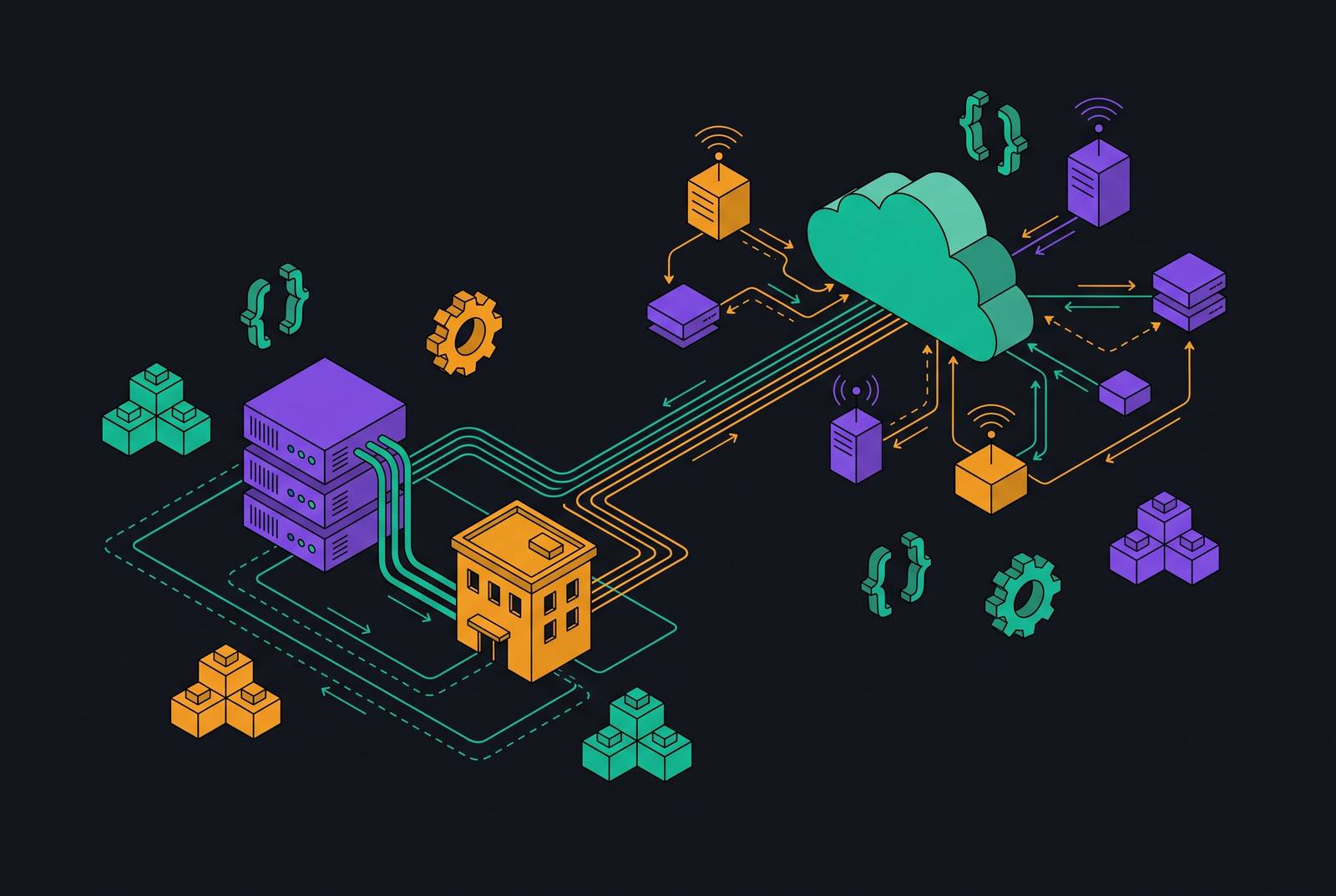
Cloud-hosted tools send prompts, code, and surrounding context to a provider's servers. Inference runs on infrastructure the vendor owns, billing runs per token or per seat, and the provider controls model updates, scaling, and most of the security posture. Self-hosted tools reverse that arrangement: model weights and the inference stack run on hardware the organization controls, such as an on-premises rack, a private cloud instance, or a VPC. Data doesn't leave the perimeter unless someone sends it out on purpose.
"Self-hosted" hides more variety than the word suggests. Full on-premises means owned or leased hardware, air-gapped if the work demands it. Private cloud or VPC means the organization manages the instance while a cloud provider still owns the underlying hardware. Hybrid means sensitive or regulated work stays on-prem while general-purpose or experimental work goes through cloud APIs. Most enterprises land in that hybrid middle because different tasks carry genuinely different risk.
Data privacy requirements shaping the deployment choice before cost or capability
Kong's Enterprise AI Report found that 44% of enterprises name data privacy and security as the top barrier to adopting large language models. For that group, privacy is a gate. It's a gate, and nothing else on the evaluation gets touched until it opens.
Cloud platforms send prompts and code over the internet to a third-party server. Enterprise API agreements typically include no-training and zero-data-retention clauses, but those clauses run on trust: trust that the vendor's policies hold, plus ongoing effort to check whether they've changed. Consumer-tier products carry weaker protections still, and conversations may get reviewed or used to improve the underlying model with no clear way to opt out. The compliance gap almost nobody audits sits right here: an engineer pastes a chunk of proprietary code into a personal account on a consumer-tier AI tool to debug something fast, on a tool nobody in security ever vetted for that purpose.
Self-hosted deployment addresses trust by architecture instead of policy. Model weights and inference run inside the organization's own environment, so prompts, completions, and code never leave unless someone routes them out deliberately. That's a different guarantee than a vendor's promise not to train on your data, and a stronger one. A self-hosted model on a poorly secured server is not automatically safer than a cloud deployment. Self-hosting means the organization now owns the entire security burden, with no vendor security team backstopping the setup when something goes wrong at 2 a.m.
There's a legal wrinkle too, and it turns architecture into liability fast. A 2026 ruling in the Southern District of New York found that documents created using commercial generative AI tools and sent to counsel are not protected by attorney-client privilege, because communications with commercial AI platforms lack the confidentiality the privilege requires. Any enterprise with in-house counsel touching AI tools now has a legal exposure question sitting on top of what used to be a purely technical one. The practical test: if a prompt might contain proprietary code, client data, or anything privileged, the privacy analysis comes first. Before anything else, before capability. Before capability. Before anything else on the list.
Regulatory and compliance constraints that make self-hosting a requirement, not a preference
GDPR, HIPAA, and SOC 2 all restrict where data can be processed and who's allowed to touch it. A cloud API that routes a prompt through a server in another jurisdiction, or hands it to a third party the organization doesn't fully control, can create a violation without anyone intending it.
Some sectors don't get to treat this as a judgment call. Defense contractors and government agencies often need air-gapped deployment outright, since AI running fully on-premises can operate with zero internet connectivity, a hard requirement in military and critical infrastructure work. Healthcare organizations can't process protected health information on a platform without a signed business associate agreement and full visibility into how that data moves. Financial services face data residency rules across multiple jurisdictions simultaneously; financial institutions increasingly run compliance automation agents on self-hosted infrastructure because sending proprietary financial data to an external server isn't a risk they are willing to take. Legal operations, meanwhile, face the SDNY ruling directly: cloud-based tools have become a concrete privilege risk, not merely a theoretical one.
Compliance isn't only about where data physically travels. It also demands an audit trail: what the model received, what it generated, what it did with that output afterward. Self-hosted deployments give organizations direct control over that logging. Cloud platforms vary widely in how much audit data they expose, and "varies" is not a word compliance officers want to hear during a review.
Agentic workflows raise the stakes further. When a coding agent runs a multi-step task, reading files, writing code, calling internal APIs, each step touches data that might be regulated. Reviewing that behavior requires traceability that's simply easier to guarantee on infrastructure the organization controls end to end. For enterprises in regulated domains, this section is the whole decision. Cost and capability only become questions once compliance has already ruled a path in or out.
The total cost of ownership calculation, and where the crossover point falls
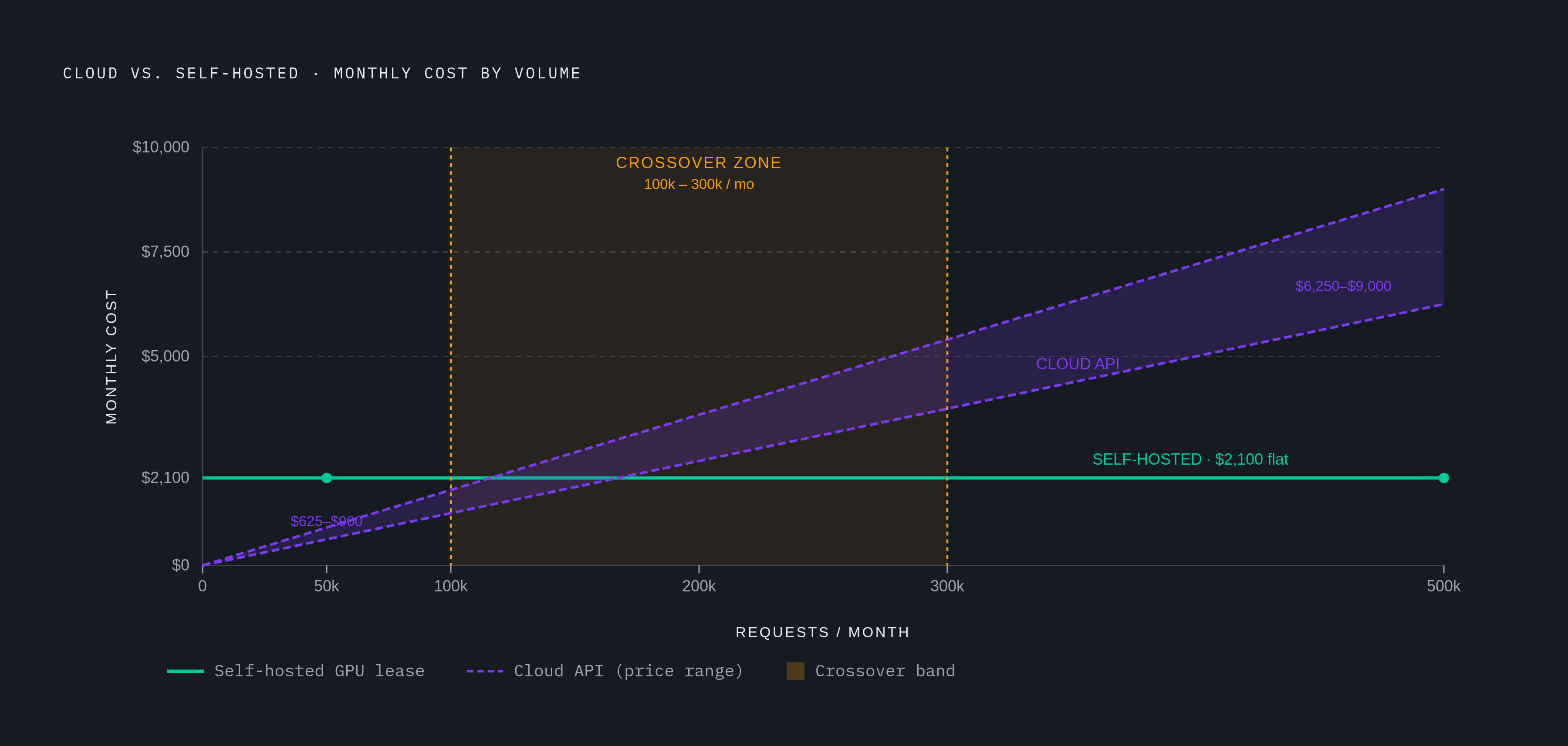
Per-token pricing looks cheap up close, and at low volume it genuinely is. A single API call costs a fraction of a cent. At 50,000 requests a month, averaging 1,000 input and 1,000 output tokens, cloud pricing runs around $625 a month on GPT-4o or roughly $900 on Claude Sonnet, against a self-hosted GPU lease running about $2,100 a month. Cloud wins comfortably at that scale, and anyone telling you otherwise at that volume hasn't done the math.
Pushing volume to 500,000 requests a month flips the picture. Cloud costs rise to roughly $6,250 or $9,000 depending on the model, while the self-hosted GPU cost holds flat, because it's a fixed lease rather than a per-call charge. The crossover for most configurations is between 100,000 and 300,000 monthly requests, and fine-tuning a smaller model shifts that line further toward self-hosting. One reported comparison at 10 million tokens a month put on-premises inference at $4 against $200 through a cloud API: a 50x gap, driven by a model tuned narrowly for the task rather than a general-purpose frontier model doing the same job at a markup.
At real enterprise scale, the gap compounds into serious money. A three-year total cost of ownership example for an enterprise running 10 billion tokens a month put on-premises spend at roughly a third of cloud API cost, a 57% saving once usage settles into a steady pattern rather than spiking unpredictably.
None of that is free money, though, and anyone pitching self-hosting as pure savings is skipping the operational cost that costs the most. Self-hosting carries operational overhead that per-token pricing conveniently hides: MLOps engineers commanding salaries above $150,000, ongoing monitoring, security patching, model updates on a cadence someone has to actually own. A realistic small self-hosted deployment needs one to two dedicated full-time engineers just to keep it running. Northflank's AI Hosting Report found GPU prices have dropped 40 to 60% since 2024, which helps the hardware side of that math get better every quarter. Each model wins under different conditions. The answer depends on volume, how steady that volume is month to month, and whether the organization already has the infrastructure and the MLOps bench to run it without hiring from scratch.
Model quality and capability gaps between frontier cloud models and self-hosted open-weight alternatives
Cloud coding agents like Claude Code and GitHub Copilot run frontier models with hundreds of billions of parameters, trained on enormous datasets with extensive reinforcement learning from human feedback. On raw capability, self-hosting cannot match that today, and pretending otherwise does teams a disservice.
The gap has a rough shape. Qwen2.5-Coder-32B, probably the strongest self-hostable open-weight coding model available, scores within 85 to 90% of Claude Sonnet on straightforward function generation. Close, not equal, and the distance widens as tasks get harder: multi-step reasoning, cross-repo refactoring, architecture decisions nobody's tackled before. As of mid-2026, the open-weight field also includes Qwen2.5-Coder in 7B, 14B, and 32B sizes, DeepSeek-Coder-V2, and Mistral's Codestral, which launched at 22B parameters.
Fine-tuning changes the equation more than raw parameter count ever will, at least for narrow, repetitive tasks. A fine-tuned Qwen 7B model reportedly outperformed GPT-4o on invoice parsing accuracy while costing roughly 25 times less per token to run. Domain fit beats scale once the task gets specific enough.
That reframes the real question for engineering leaders: does the quality gap appear on the hard multi-step reasoning and novel architecture calls that matter, or is most of the daily workload autocomplete, test generation, and boilerplate, where a fine-tuned local model already matches or beats cloud output? The strongest setups don't pick one answer for everything. They route: local models take the high-volume or sensitive work, cloud APIs get called in for the complex or one-off cases, and quality stays where it counts while cost and exposure stay controlled everywhere else.
AI coding agents in self-hosted and cloud deployment
Claude Code has moved a long way past being a thin command-line wrapper around a model. Anthropic shipped the Model Context Protocol in November 2024, then layered in hooks, slash commands, subagents, IDE integrations for VS Code and JetBrains, a desktop app, and memory-consolidation capabilities.
The more consequential move came in August 2026, when Anthropic announced self-hosted runners for Claude Code in public beta. The feature moves cloud sessions off Anthropic's own infrastructure and onto servers inside the customer's network, available to Claude Team and Enterprise plans, switched off by default. Sessions kicked off from the web, mobile, desktop, terminal, or a scheduled routine run next to the organization's own internal services, toolchains, and security controls. This matters because it splits apart two things that used to travel as one: the model, which stays frontier-grade and Anthropic-hosted, and the execution environment, which now belongs to the customer.
Cursor took a parallel but different path, growing into a general-purpose AI development environment rather than a thin agent wrapper. Its core features include a multi-file agent mode, Model Context Protocol support added in 2025, a model picker covering Claude, GPT, Gemini, and custom endpoints, per-repo configuration guidance, and automated fix capabilities. On the enterprise side, Cursor's Cloud Agents run in isolated virtual machines that can be either Cursor-hosted or self-hosted. Organizations running self-hosted agents pay their own compute costs for worker execution, while Cursor-hosted agents come with infrastructure Cursor manages directly. Reaching the high-reasoning models still requires an outbound connection to Cursor's orchestration layer, and fully air-gapped environments require working directly with Cursor on a bespoke network arrangement. It's not the default, and enterprise teams should expect to ask for it explicitly.
Teams that need something fully self-contained have open-source options too. Continue.dev is an open-source extension for VS Code and JetBrains that connects to local models through Ollama or to cloud APIs, and it supports mixing local and cloud routing inside the same setup. pairing an open-source agent like Aider with a locally run open-weight model offers a path toward genuinely air-gapped self-hosted work with no cloud dependency in the loop.
A pattern is settling in across all of these. The frontier model itself mostly stays cloud-hosted, but the agent's execution environment, its file access, its tool calls, keep moving inside the customer's network. That dissolves the old binary and replaces it with a sharper question: where does execution happen, and separately, where does inference happen?
MCP, the context layer, and what "self-hosted" means for AI coding agents
The Model Context Protocol, introduced by Anthropic in November 2024, is an open standard for how AI applications connect to external tools, data sources, and workflows through one consistent interface. People have called it USB-C for AI applications, and the comparison holds up: one plug shape, many devices on either end.
Adoption moved fast by any measure. MCP server downloads went from roughly 100,000 in November 2024 to more than 8 million by April 2025. By the time Anthropic donated MCP to the Linux Foundation's Agentic AI Foundation in December 2025, the ecosystem had grown to more than 10,000 active public MCP servers and over 97 million monthly SDK downloads, with more than 5,800 MCP servers and 300-plus MCP clients now in circulation.
That growth matters for self-hosted deployments specifically, because MCP decides what an agent can actually see and touch, regardless of where the model itself runs. A coding agent calling a frontier model in the cloud can still route every tool call, every file access, every data retrieval through MCP servers running entirely inside the organization's own network. The model does its reasoning off-site while the sensitive part, the context, stays home. That's a different shape of "self-hosted" than the one enterprises were choosing between even a year earlier, when the only real options were keep everything in-house or send everything to the vendor. The context layer now lets an organization draw that line itself, task by task, instead of accepting whatever line the deployment model happened to draw for it.