Multi-Repository Discovery Patterns That Let New Engineers Answer Their Own Questions
Structured discovery patterns help new engineers navigate multi-repo codebases independently.
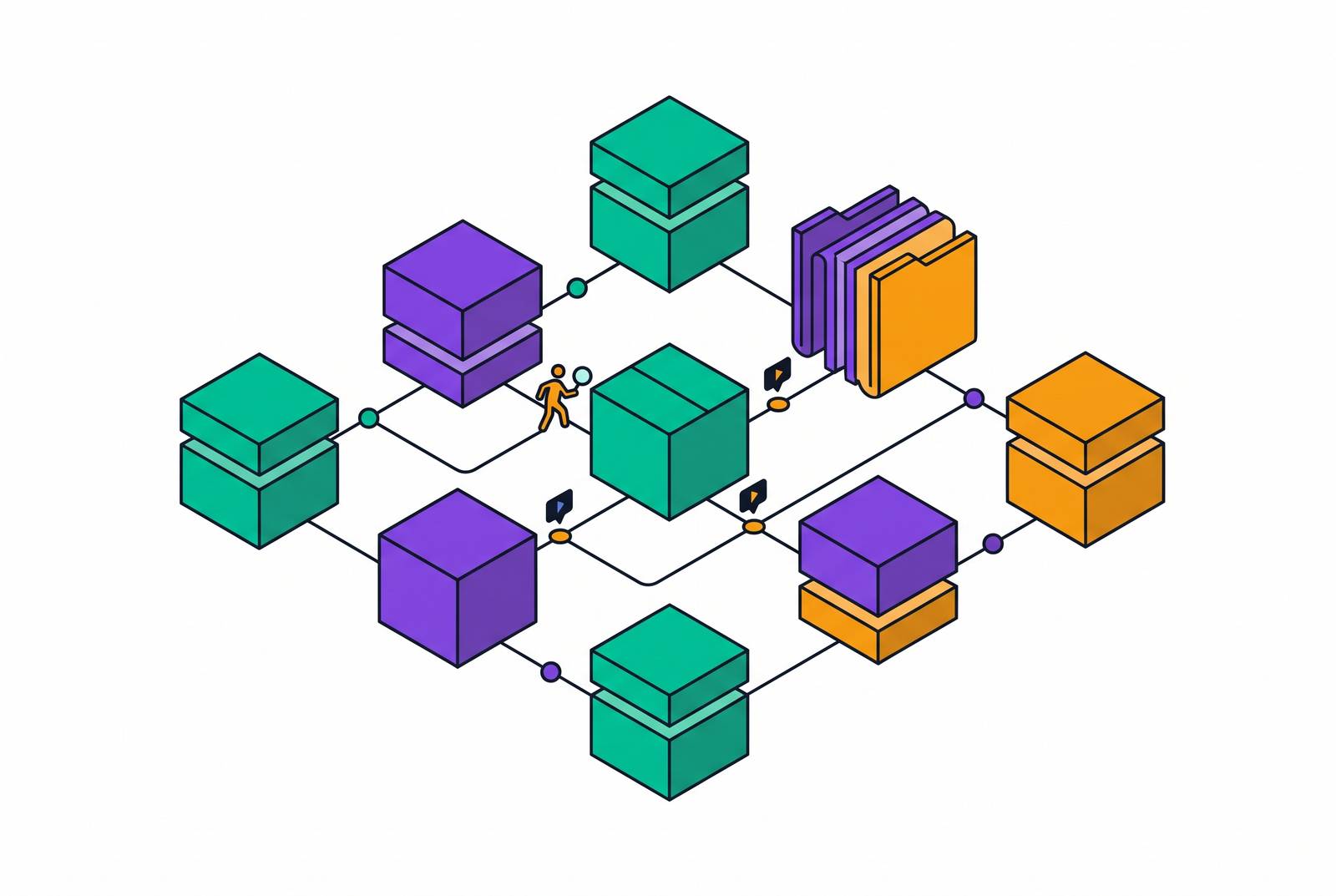
Multi-repository codebases fail new engineers not because they are large but because they were never designed to be queried. The knowledge required to work safely lives in senior engineers' heads, not in any artifact a new hire can reach alone. The fix is a structured set of discovery patterns that turn an opaque file store into a self-service knowledge system.
Why multi-repo codebases become knowledge dead zones for new engineers
The canonical first week in a multi-repository codebase follows a predictable loop: clone the repo, grep for clues, message a senior on Slack, repeat. It is that the knowledge required to break the loop lives in senior engineers' heads, distributed across years of accumulated context that no single artifact captures. Every iteration of the loop costs two people time: the new hire who stalls, and the senior engineer whose deep work is interrupted.
Repowise's onboarding breakdown names four distinct jobs a new hire must complete before they can contribute safely: orient on structure and entry points, find where a change belongs, recover the reasoning behind existing design, and understand blast radius and ownership. Each requires a different kind of context: structural, locational, historical, relational. Raw file access gives a new engineer bytes and directory trees, which address none of those four directly.
The real cost of this design flaw falls on the senior engineers, not the new ones. Every question that cannot be self-answered becomes an interruption, and each interruption pulls a senior out of the deep work that only they can do. A codebase that cannot answer its own questions taxes its most expensive resource.
The flaw is fixable because it is structural, not cultural. A doc is a snapshot of a moving system, and it starts drifting the day it is merged. What a new engineer needs is an accurate answer to a specific question at the moment they ask it, grounded in the code as it is today.
The four jobs that define successful codebase onboarding
Onboarding is not a single event but four ordered jobs, and failure at any one blocks the jobs that follow. Understanding this sequence is what makes the discovery patterns in this article actionable rather than abstract. The four jobs build on each other, and each requires a different kind of context.
The first job is structural orientation: where does X live? This means building a mental model of how the system is divided, what each repository or module owns, and where the entry points are. It must come first because without it every subsequent search is directionless. The second job is locational precision: where does the change belong? The third job is design reasoning: why is it built this way? This means recovering intent from commit history, architectural decision records, comments, and architectural patterns so the new engineer does not repeat a solved problem or violate an established constraint. The fourth job is blast-radius awareness: what breaks if this is touched? This requires tracing dependency relationships across repositories to understand what other services, teams, or integrations a proposed change would affect before the change is made.
The four jobs are strictly sequential. A new engineer who cannot orient cannot locate. One who cannot recover reasoning cannot assess risk. A discovery pattern that skips a job or applies them out of order leaves the new hire stranded partway through, holding a mental model that cannot support the next step.
Pattern 1: Building a structural map before reading any code
The first discovery pattern addresses the orientation job directly: read the shape before reading the files. The goal is not comprehensive understanding. It is a one-page mental model that the engineer can revise as they proceed, the rough territory drawn before the details are filled in.
The artifacts to start with are the ones that describe structure without requiring code comprehension: README files, package manifests, lockfiles, top-level folder names, the build system, the test runner, deploy targets, and entry points. These give a new engineer the product boundary, where control enters the system, the main modules and layers, and which areas are likely to be risky. From these, the engineer can form a working map of the territory.
The challenge is that architecture diagrams are almost always out of date when maintained by hand. For public repositories, Cognition's DeepWiki provides a zero-setup starting point: it has pre-indexed a large number of popular public repositories, generating browsable wikis and Mermaid architecture diagrams with no sign-up required. Treat it as a starting point to verify against the actual source, not as an authoritative map.
For private or enterprise repositories, the pattern requires a tool that generates the map from the code on each commit. Sourcebot occupies a different position in the same mechanism: its cross-repository indexing builds a searchable dependency graph and ownership data from git history, incrementally updated, so a new engineer can orient on structure without waiting for stale documentation. This kind of tooling makes orientation a property of the codebase itself rather than a documentation maintenance burden.
Pattern 2: Using cross-repository search to locate exactly where a change belongs
Once a new engineer has a structural map, the next job is locational precision. It is that search is scoped to a single repository by default. An engineer who searches only the repo they cloned may miss the canonical implementation, the shared library, or the configuration that lives elsewhere.
The pattern is straightforward to describe and harder to practice consistently: formulate the question as a search query, whether a function name, an API endpoint, a configuration key, a class or an interface, and run it simultaneously across all repositories in the organization. Cross-repository search that finds every use of a function, API, or pattern across all repositories simultaneously transforms debugging, refactoring, and API migration from tedious manual tasks into fast batch operations. Understanding a function's complete call graph in a distributed system takes seconds rather than hours.
Harness's source context management analysis makes the stakes concrete with a rate-limiting example. Cross-repo search is what surfaces all three. The failure mode is not that the engineer cannot find code. It is that they find only the local instance and invent a second pattern where one already exists.
For enterprise environments, Sourcebot is built precisely for this pattern. A new engineer can ask where an interface is implemented and get an answer that spans all eighty repos, not just the one they have open. The pattern assumes the organization grants appropriate read access as part of onboarding, not after the first ticket is blocked.
Pattern 3: Tracing dependency relationships to recover design reasoning
Finding a piece of code is not the same as understanding why it exists. The third discovery pattern addresses the design reasoning job: recovering intent from the dependency relationships and history that explain how the current structure came to be. New engineers who locate the right file but misread its purpose make changes that break unstated contracts. They satisfy the ticket but introduce an architectural regression because they did not know what the code was protecting.
Dependency graphs surface the structural reasoning behind a design. They show which modules depend on this one, what this module must not change without coordination, and which callers will break if an interface shifts. This is a preview of the blast radius job that follows, but it also answers the "why" question directly: the constraints a design is satisfying become visible when the things that depend on it are visible.
The highest-fidelity sources of design reasoning are architectural decision records stored in the repository. ADRs record not just what was decided but what alternatives were considered and why they were rejected. As of 2026, AGENTS.md is read natively by OpenAI Codex CLI, Cursor, Aider, Devin, GitHub Copilot, and Windsurf. Claude Code reads it as a fallback when no CLAUDE.md is present. Gemini CLI requires opt-in configuration. Committing architectural context once makes it available to any agent the team uses, and a new engineer reading it gets the same grounding.
The limitation of raw file access is semantic blindness: reading files does not tell an engineer why code is structured the way it is, what modules depend on what, or which functions are high-risk. Natural-language querying over the design-reasoning sources becomes the practical bridge between what the code does and why it was built that way. Tools like Sourcebot let new hires query intent across all repositories at once, surfacing the reasoning behind constraints without needing to know which file or service holds the answer. Sourcebot's Deep Search interface makes this concrete: a new engineer can ask why the authentication flow goes through a particular middleware and receive a cited, navigable answer that draws on the full codebase.
Pattern 4: Tracing blast radius before proposing any change
The most consequential mistake a new engineer makes in a multi-repo system is proposing a change without knowing how many other services, teams, or integrations it will affect. Blast-radius tracing, done before writing code, is what prevents it. The problem is uniquely severe in multi-repo environments: a change to a shared interface or a deprecated API field may be safe within the repository the engineer is working in but break four other services in separate repositories owned by separate teams.
The pattern is disciplined and explicit: before writing code for any change that touches a shared interface, configuration key, API endpoint, or exported symbol, query what depends on that symbol across the full codebase. A widely cited enterprise AI failure mode illustrates exactly what goes wrong when this step is skipped. The same failure mode applies to a new engineer working without cross-repo visibility, except the rejected PR lands on the engineer's own record.
Cross-repo search is the mechanism. The blast-radius pattern is the discipline of applying it proactively rather than reactively. Sourcebot's organization-wide indexing makes such queries practical: finding all references to an exported function across all repositories is a query the platform answers in seconds, returning every callsite with file and repo context. Without that, a new engineer must either ask a senior or ship a PR that will be rejected.
The common objection is that blast-radius tracing slows down new engineers who are already moving cautiously. A rejected PR that breaks a downstream service costs far more time than a pre-submission search query. The pattern replaces a reactive cost with a small proactive one, and it converts a risk-laden first contribution into a defensible one.
How natural-language querying ties the four patterns together at scale
The four discovery patterns are only self-service if the interface for running them requires no prior knowledge of the codebase. A new hire who does not yet know the name of the module, the function signature, or the location of the ADR cannot run these patterns effectively with a keyword search interface alone. This is the expert-knowledge problem, and it is the point at which the patterns stall for the very people they are meant to help.
Natural-language querying inverts the dependency. Harness's analysis frames precomputed semantic context as the difference between an agent that hallucinates implementations because it missed a key abstraction three directories away and one that writes code fitting established patterns on the first pass. The same framing applies to human new hires: without a queryable context layer, they guess. With one, they navigate.
The same interface serves non-engineers. This extends the self-service model beyond new developers to the broader organization, which is precisely where the interrupt load on engineering teams originates. Sourcebot's Ask Sourcebot interface is built for this use case: any user can ask questions about the codebase in plain language and receive answers that cite the specific files and repositories they came from, all without the code leaving the company's infrastructure.
Connectors extend the query surface beyond code. The governance consideration is worth stating plainly: as MCP adoption matures, best practice is moving toward curating a small set of high-signal tools per agent rather than connecting every available server. A well-governed context layer returns precise, cited answers rather than overwhelming results.
The data-privacy constraint that determines which infrastructure is viable for enterprise codebases
For engineering teams at enterprises with sensitive or proprietary codebases, the discovery infrastructure that makes these patterns work must run inside the company's own environment. This is not a theoretical concern. Using a cloud-hosted discovery tool by default can mean proprietary code, the same code the discovery patterns are designed to navigate, becomes part of external model training unless every developer on the team takes explicit opt-out action.
Self-hosted deployment resolves this constraint. A discovery platform that runs inside the company's own infrastructure processes and indexes code without it ever leaving the network boundary, making the privacy constraint a deployment decision rather than a feature trade-off. This is the engineering-correct solution for enterprises, and Sourcebot is designed around it: a single Docker container deployment removes the infrastructure overhead objection, and feature parity with cloud-hosted alternatives is a function of the platform, not the deployment model.
The bring-your-own-model dimension matters too. Self-hosted deployment should mean choosing which LLM the natural-language layer uses and where that model runs. The principle is simple: the codebase should be queryable from day one without the company surrendering control over where its code and queries are processed.
Applying the four patterns from day one: a sequenced starting point for new engineers
The four discovery patterns are most effective when applied in strict sequence: map the structure, locate the work, recover the reasoning, assess the blast radius. Each pattern builds on the mental model the previous one established, and skipping a step leaves the new engineer with a gap that compounds downstream. The sequence is concrete enough to be a day-one protocol.
Before reading any code, retrieve or generate a structural map of the repositories involved in the first ticket. Before proposing a design, read the ADRs and AGENTS.md files in the relevant repositories, and query the codebase in natural language for how the feature in question is implemented, to recover the established pattern before inventing a new one. Before opening a PR, explicitly query blast radius: find all references to the symbols the change modifies across all repositories and name the teams that own the affected services, then loop in those teams before review, not during it.
The benefit is measurable. The pattern set is not just an onboarding tool. It is a structural reduction in the interrupt load the codebase generates. Sourcebot's free tier, which allows engineering teams to index real repositories and prove the value of cross-repo search and natural-language querying before any procurement decision, makes the patterns available to validate against a team's actual codebase without a purchasing commitment. The sources checked for this guide are listed below.