Reducing New Engineer Ramp Time With Code Search and Navigation Tools
Code search tools let new engineers find answers without interrupting teammates.
Engineers ramp slowly because they can't find code, trace it, or understand why it was written that way.
What causes new engineers to be slow to contribute
A new hire who writes clean, fast code at a previous job does not suddenly forget how to program on day one somewhere new. What they lack is a map: which service owns which behavior, where a given function is actually called from, which of three competing patterns in the repo is the one still in use. Cycloid's 2026 guide to developer onboarding breaks the process into five stages (access provisioning, environment setup, codebase orientation, first task completion, and team integration) and the stage that drags longest is orientation, because it depends on institutional knowledge that usually lives nowhere written down. Enboarder's engineering onboarding guide makes a related point directly: critical context lives inside specific engineers' heads. Enboarder treats structured knowledge transfer as a requirement because of that. Valorem Reply's onboarding framework notes that a senior engineer spends a significant chunk of time answering basic questions for each new hire, and the same questions resurface every single ramp cycle, because nothing about the last cycle's answers got captured anywhere searchable. That recurring tax has a name in the onboarding cost literature: senior mentor drag, where a senior individual contributor can spend 20 to 40 percent of working hours in a new hire's first three months on questions, PR reviews, and architecture explanations. None of this is fixed by hiring better engineers. It's fixed by giving engineers, of any skill level, a way to find and understand code without routing every question through a person.
The ramp curve phase by phase, and where it stalls
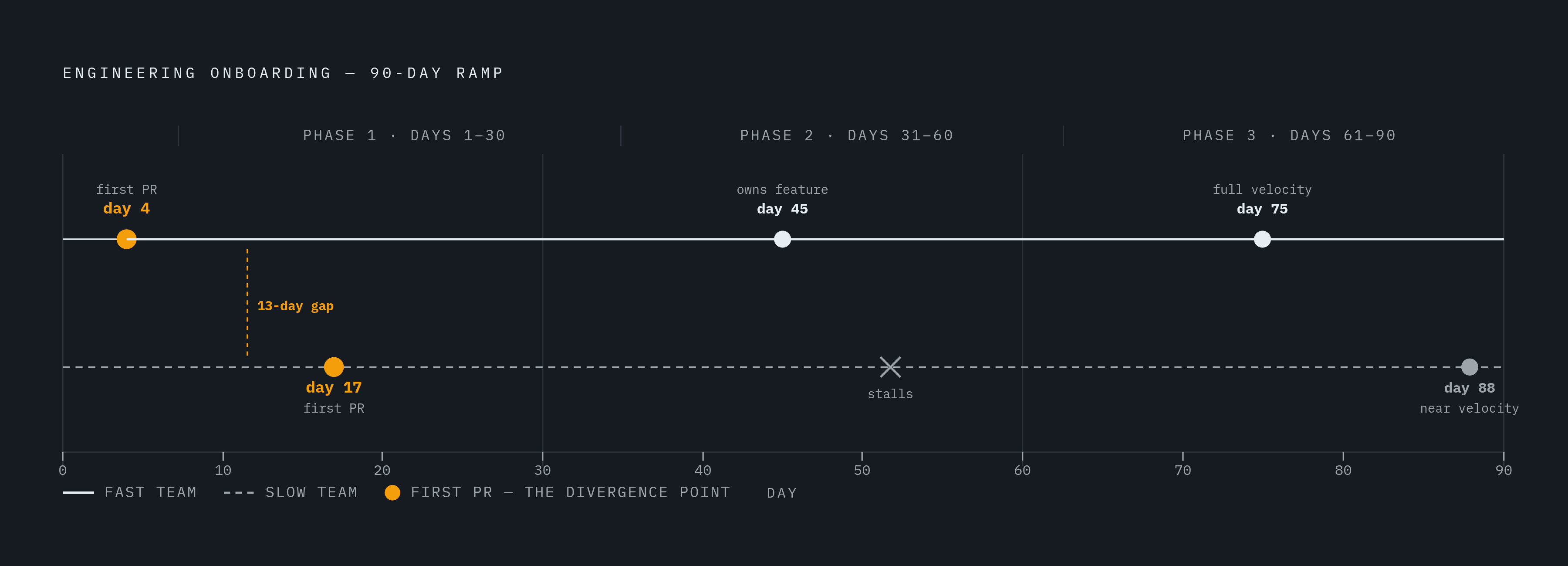
Valorem Reply's framework sets a benchmark for the first 30 days: a first meaningful pull request merged by day five to seven. That target slips constantly, and the reason is rarely that the new engineer can't write the code. Environment setup and codebase orientation simply take longer than the plan assumes. Cycloid's automated onboarding model treats codebase orientation as something that should take two to four hours, but only under a specific condition: a software catalog that exposes service ownership, dependency maps, API documentation, and architecture decision records from a single place. Manual onboarding offers none of that, so the two-to-four-hour target becomes days instead.
The next phase, days 31 to 60, is where Valorem Reply expects a new engineer to own small features end-to-end and review teammates' code with minimal guidance. This is exactly the phase that stalls hardest, because owning a feature end-to-end requires navigating the codebase independently, and an engineer who still can't do that by day 31 has nowhere to go but back to asking people. By days 61 to 90, the same framework sets the bar at velocity indistinguishable from established team members. That bar is unreachable for anyone still hunting for basic context in week eight.
The phase-by-phase picture also splits by seniority. Enboarder frames it sharply: a junior engineer needs structured guidance, while a senior engineer needs context and autonomy, and conflating the two produces an onboarding plan that serves neither well. CorrectContext's guide to onboarding senior engineers makes the point more pointed still. Senior hires don't need to be taught how to code. They need to understand system architecture, deployment pipelines, and business logic, and they expect to find that information themselves rather than schedule a meeting to get it explained to them.
Why scattered documentation fails to solve the context problem
The standard response to slow onboarding is to write more documentation, and it is also the response that reliably fails. Valorem Reply's framework is blunt about the mechanism: slow teams rely on documentation written once and never touched again, and new developers quickly stop reading pages they've learned not to trust. The failure is that whatever got written down stopped matching the system the moment the system changed, and nobody updated the page to match.
Picture a new hire searching an internal wiki for "local environment setup" and finding three different guides, each written at a different point in the system's history, each contradicting the other two. At that point the new hire does the rational thing: stops trusting the search results entirely and goes back to asking a person directly, which reproduces the exact interrupt pattern the documentation was supposed to eliminate. Enboarder names this as one of the traits that makes engineering onboarding unlike onboarding in any other function: knowledge lives with people, not with documents, and no amount of wiki investment changes that on its own. The gap between what's documented and how the system actually behaves widens fastest in large or legacy codebases, which happen to be exactly the environments where ramp time is already longest.
CorrectContext's guide offers the more useful framing: the lever that makes a metric like "time to 10th pull request" improvable is giving new hires a way to ask questions about the codebase and understand the reasoning behind architectural decisions without pulling a peer away from their own work. Documentation decays because it's maintained separately from the code it claims to describe, while the codebase itself never goes stale in the same way. Sourcebot and similar code context layers are built on that premise: treat the repository as the one source of truth, let new engineers query it directly, and the maintenance burden that makes traditional docs so unreliable simply doesn't apply, because there's no second copy of the truth to fall out of sync.
Code search changes the orientation phase from guided tour to self-serve exploration
If scattered docs fail because they drift from the code, the fix is to search the code directly. Cycloid's model of a well-maintained software catalog, exposing service ownership, API docs, dependency maps, and runbooks from one place, removes the need for a senior engineer to explain where everything lives. Code search applies the identical logic one level deeper: instead of a catalog describing the services, it searches the actual source, so a new engineer can ask "where is our authentication logic defined?" and get a cited, navigable answer rather than a Slack reply from someone three time zones away.
Sourcebot is one example of a tool built around that mechanism. It's a self-hosted code intelligence platform that gives new engineers, and non-engineers like product managers and support staff, instant answers across every repository through natural-language queries, grounded in the actual code rather than in documentation that might be months out of date. Its Ask Sourcebot interface extends the query beyond the repos themselves, pulling in connected tools like Jira, Slack, and Linear, so a question about a piece of code can surface both the relevant function and the ticket or discussion that explains why it exists. Underneath that, the platform runs fast regex, symbol, and filtered search across every repo and branch, with go-to-definition and find-references navigation built in, so an engineer can trace a call chain or locate a pattern without first figuring out who on the team would know the answer.
The gap this closes appears directly in Valorem Reply's benchmark numbers: fast teams merge a first meaningful pull request by day three to five, while slow teams take until week two or three, and the difference comes down to whether the new engineer can find what they need without flagging someone down. Orientation becomes something the new engineer can do on their own time, at their own pace, as many times as a question comes up, instead of a scheduled walkthrough led by a senior engineer.
Code search reduces the senior engineer interrupt load during active contribution
The interrupt cost doesn't end once orientation is over. It compounds across the contribution phase, when a new engineer is nominally working independently but still lacks the fluency to answer their own questions about the system. Valorem Reply puts a number on a single mentor relationship: three to five hours a week of a senior engineer's time for one new developer, and that figure multiplies fast once several new hires are ramping at once and asking overlapping questions.
Those questions are rarely novel. "How do I run the test suite?" "What's our branching strategy?" "How does staging actually deploy?" Each one is answerable from the codebase itself, making each one a candidate for search. Code search with symbol-level navigation, go-to-definition and find-references in particular, lets a new engineer trace a call chain on their own instead of asking a teammate to walk through it line by line, turning what used to be a five-minute interrupt into a search that takes thirty seconds. Connecting that search to external tools through MCP-based connectors, the approach Sourcebot takes, adds a layer most pure code search tools miss: understanding not just what a piece of code does, but why that particular pattern exists, without opening five browser tabs and pinging a product manager to ask.
The relief runs in both directions. The senior engineer gets fewer interrupts during focused work, and the new engineer gets to act on their own judgment instead of waiting in a queue for somebody else's attention, which is the aligned-autonomy principle CorrectContext describes for senior hires, applied here across the whole team regardless of seniority. The same gap occurs outside engineering. Product managers, support staff, and compliance reviewers all run into the same wall when they need to understand what a piece of code does, and a natural-language interface to the codebase, which is part of Sourcebot's stated positioning, extends the same interrupt reduction to them, which in turn takes load off the engineers who would otherwise be the ones translating code into a plain-language explanation on request.
AI coding agents and codebase context for new engineers
AI coding agents are now a standard part of how engineers at every level work, including engineers in their first weeks on a team, and that shift changes what "codebase context" has to mean. CorrectContext notes that embedding AI tools into onboarding lets new hires ask questions about the codebase and understand architectural decisions without constantly pulling a peer aside, but that benefit depends entirely on one condition: the agent needs access to the right context in the first place.
An agent running only against the files open in a local editor is, functionally, in the same position as a new engineer with no documentation. Asking it how the authentication service integrates with the billing API gets an answer no better than a blank search of the local checkout, because it cannot see the billing API's code. Closing that gap requires an agent that can reach across the entire organization's repositories, not just the one open on a laptop. Sourcebot works this way as a context layer: it gives coding agents running inside tools like Cursor or Claude Code access across every repository in the organization through an MCP-based connector.
The Model Context Protocol architecture that enables that connection matters structurally, not just as a convenience. It means the same organizational context is available to agents regardless of which tool an individual engineer prefers, so a new hire working in Cursor and a senior engineer working in Claude Code are drawing from the identical base of knowledge rather than two separate, possibly inconsistent, views of the system. Sourcebot also supports a bring-your-own-model approach, working with OpenAI, Anthropic, Bedrock, Vertex, Mistral, and self-hosted models using an organization's own API keys. Engineering teams decide for themselves where their code gets sent. For onboarding specifically, the practical effect is that the agent an engineer already reaches for becomes a second channel for the same answers code search provides.
Why self-hosted deployment matters for searching the codebase
None of this works if the tool that searches the codebase can't be trusted with the codebase itself. For most enterprises, a company's source code is among its most sensitive assets, on par with customer data or financial records, and a code search or agent-context platform that routes that source code through an outside vendor's cloud infrastructure asks a question many security and compliance teams aren't willing to answer with yes. That makes deployment model a gating question, evaluated before any feature comparison, rather than a detail to settle after a tool is already selected. A self-hosted option, deployed inside a company's own infrastructure, keeps the decision about where code travels in the hands of the team that owns the code, which is the only arrangement that satisfies a regulated or security-conscious engineering organization by default.