Bring-Your-Own-Model Configuration for Code Intelligence Platforms
Model choice has become a compliance requirement, not just a feature preference.
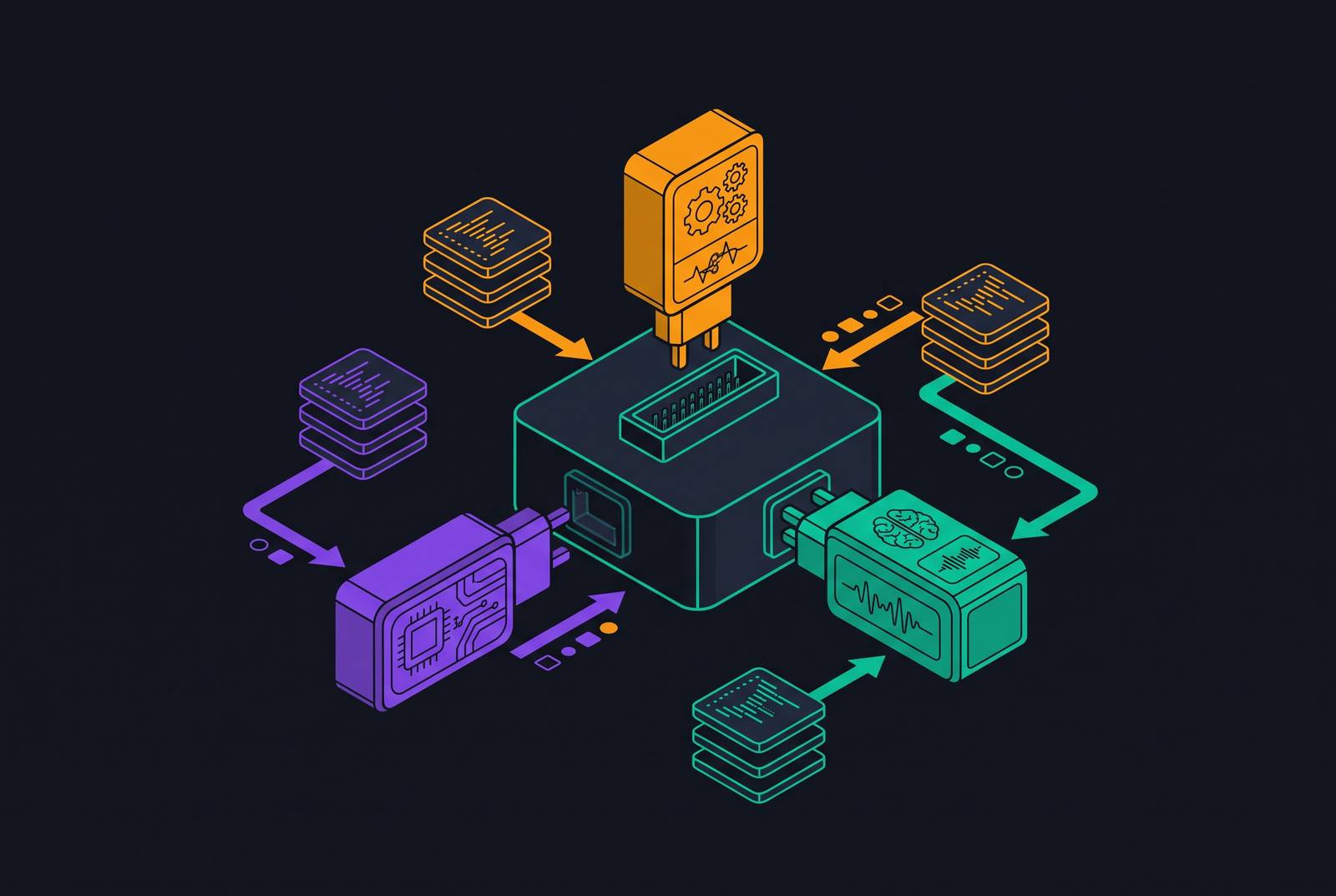
Bring-Your-Own-Model Configuration for Code Intelligence Platforms. Bring-your-own-model configuration decouples the LLM from the code intelligence platform itself, and understanding how that architecture works (and what it controls) helps engineering teams make informed decisions about model choice, data residency, and long-term flexibility.
What BYOM means
Bring-your-own-model configuration lets an enterprise plug its own LLM provider account, its own endpoint, or its own self-hosted model into a code intelligence platform, so inference runs under the enterprise's chosen provider, region, credentials, and policies rather than whatever the vendor picked by default. That sounds simple. It isn't, mostly because the market has let three separate ideas blur into one marketing term, and the blur matters a great deal to anyone whose job is signing off on where company code actually goes.
Start with BYOM itself, sometimes called BYOLLM https://www.alation.com/blog/bring-your-own-model-byom/. Owning the provider account doesn't answer every question a reviewer needs answered, though: which region actually resolves the request, what context travels along with the prompt, and whose safety guardrails apply once the request lands. Those are three separate facts, and BYOM alone confirms none of them https://www.alation.com/blog/bring-your-own-model-byom/.
Then there's BYOK, bring your own key, which gets confused with BYOM constantly despite governing an entirely different problem. BYOK is about data at rest, about who can decrypt what's stored. It says nothing about the inference path, nothing about which server processes a prompt in real time. Self-hosting is the third term, and it's the one with real teeth: the enterprise runs the model on its own hardware or inside its own VPC. That buys direct control over model provenance and patch discipline, at the cost of taking on operational work a vendor would otherwise carry.
BYOM changes who processes a prompt and where. BYOK changes who can unlock stored data. Self-hosting changes who actually runs the model.
None of this is a reason to dismiss BYOM. It's a reason to read the label closely, because the promise built into the term is narrower than the category name suggests. BYOM has stopped functioning as a differentiator between vendors, and any procurement team still scoring it as one is grading on the wrong curve. It's a baseline now, a starting condition rather than a competitive edge.
Why engineering teams are demanding model choice now
The pressure driving this comes from risk functions. McKinsey's AI Trust Maturity Survey found that security and risk concerns, ahead of regulatory uncertainty and ahead of technical limits, are the top reason agentic AI projects stall before reaching full scale, with nearly two-thirds of respondents naming that concern first https://www.alation.com/blog/bring-your-own-model-byom/.
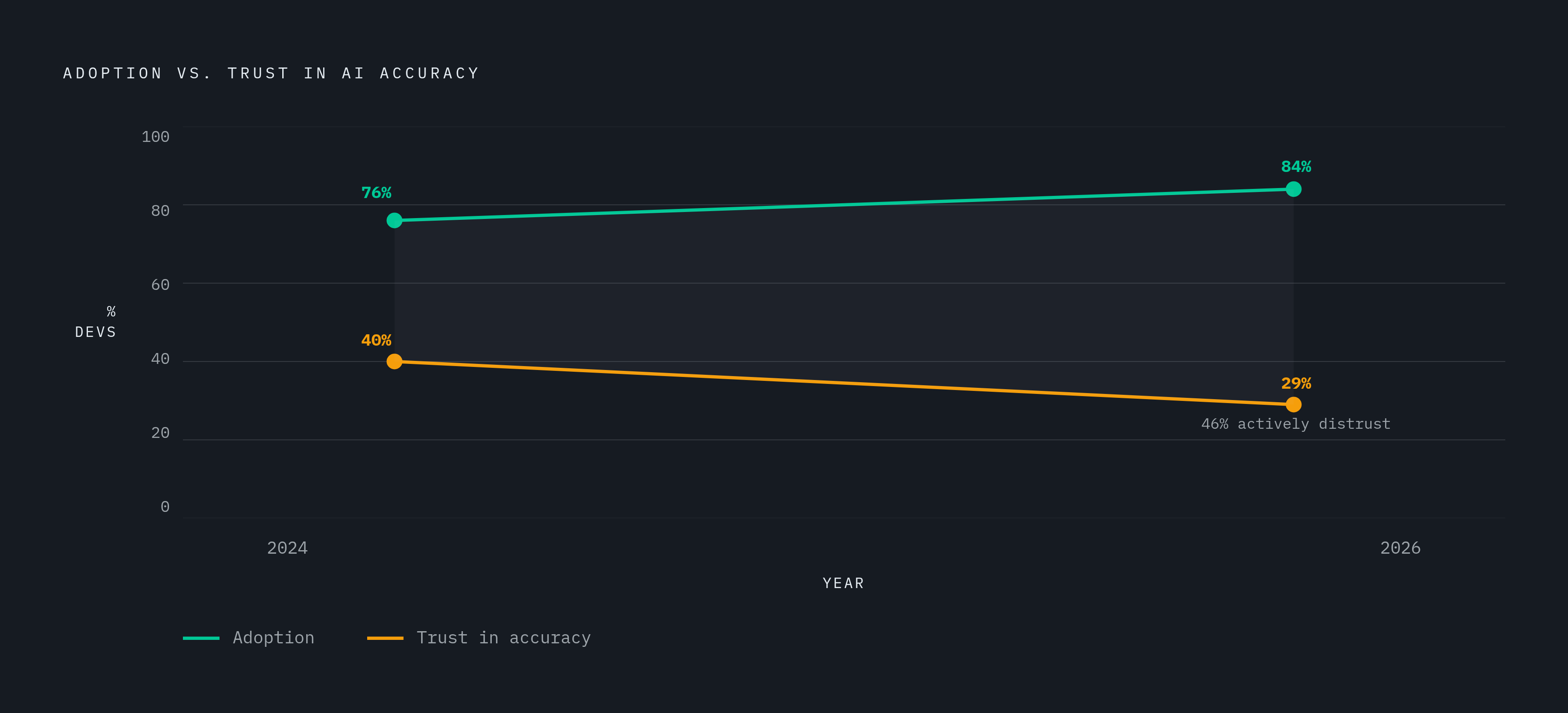
Adoption keeps climbing while trust keeps falling. Usage and confidence have decoupled, and that gap is exactly the kind of thing a compliance department is trained to notice, and exploit, during vendor review.
Cribl's BYOM launch in March 2026 named the actual blockers without softening them: internal policies permitting only pre-approved AI providers, data residency rules that rule out public internet inference outright, and security teams worried, specifically, about intellectual property leaking through a prompt window. None of this is a rare edge case reserved for defense contractors or hospitals anymore. These same concerns appear as ordinary procurement blockers in mainstream enterprise deals.
The vendors have noticed, and moved accordingly. Nearly every enterprise AI vendor ships some form of BYOM today, and the roster reads like a cross-section of the industry: Microsoft, Palantir, and Salesforce all offer one. When that many large vendors converge on the same feature independently, the convergence itself is the signal worth reading. Buyers have made model flexibility a line item in procurement. Trust has not followed adoption at anywhere near the same pace, and a vendor optimizing for the first number while ignoring the second is solving the wrong problem.
The four control surfaces a BYOM implementation governs
A useful test for evaluating any BYOM claim: if the implementation can't answer four specific questions, what's been built is a configuration field, not a control. That distinction sounds pedantic right up until it's the thing standing between an engineering team and a signed compliance review.
The first surface is provider and endpoint, and it comes down to one question: which company actually processes the prompt? This is what separates a real "any model" claim from a hollow one. A fixed provider list, such as Salesforce's BYOLLM support for four named foundation model providers (Amazon Bedrock, Azure OpenAI, OpenAI, and Vertex AI) plus a separate open-connector path, gives a customer choice within the vendor's roadmap. An arbitrary base URL for an OpenAI-compatible endpoint gives choice within the customer's own infrastructure instead, including the option to point at a self-hosted inference server like vLLM or Ollama.
The second surface is region: where does the inference physically happen? "We support data residency" is a phrase, not an answer. Compliance readers check whether their specific jurisdiction gets named by the system, and a configuration that resolves to a named, verifiable region after the fact is worth something concrete. A dropdown labeled "location" with no way to confirm what actually happened is worth nothing, and buyers who accept it at face value are buying a promise, not a mechanism.
The third surface, credentials, may be the most revealing architectural detail in any BYOM implementation. Who owns the key, and can it be rotated without breaking something downstream? When a credential is treated as its own object, created first, validated on its own, then referenced by ID elsewhere, that's genuine separation of duties: security owns the credential, and the data team owns which workload gets to use it. When the credential is just typed into the same form field as the model name, that's a configuration field again, not a control. Palantir's model shows what the separated version looks like in practice: only Enrollment administrators can register a model, source permissions stay decoupled from end-user access once a model is registered, and any model can be disabled instantly from Control Panel.
The fourth surface is guardrails, and it follows the same logic as the other three: whose policy engine actually inspects the prompt and the response before either one leaves the system? If the honest answer is "nobody's, beyond the provider's own defaults," the control doesn't exist yet, no matter what the configuration screen implies.
How BYOM is configured in practice: what the setup flow involves
Across the implementations, two model source patterns keep appearing. The first is a REST API source: an externally hosted model provider connected through its standard API, the recommended route whenever the model already exposes a normal interface. Palantir calls this configuration a "REST API source," set up inside Data Connection. The second is the compute module or self-hosted route, where the model runs on hardware the customer controls: on-premises, fully air-gapped, or fronted by a custom proxy layer.
Cribl's setup flow is a useful, concrete example of what this looks like from inside an admin panel. An administrator goes to Settings, then Global, then AI Settings, and clicks Use Custom AI Provider. From there, the provider type gets selected, and the Provider ID, deployment URL, and API key get entered. Before anything saves, the connection gets tested, which validates the credential as its own separate step instead of trusting it blindly. Once the configuration is saved, every AI feature inside that Workspace routes through the provider just configured. Cribl has said a future update will let different AI features within the same Workspace point at different models, rather than forcing one model to serve every feature uniformly.
What this setup flow does not hand an administrator is infrastructure management. Palantir's registered models documentation treats rate limit enablement, usage observability through Resource Management, and permissions through Control Panel as separate layers, sitting on top of whichever model got registered.
Organizations that already have AI governance infrastructure in place can route BYOM traffic through an internal gateway, such as LiteLLM, rather than calling model providers directly. An organization already using a gateway to monitor usage, enforce policy, manage keys, and track cost can extend that same governance into a new platform without opening a fresh, unmonitored path around it. That's not a small detail: BYOM that plugs into existing oversight tends to stay governed. BYOM that quietly opens a second, ungoverned door into the same sensitive systems does not.
Where self-hosted models fit inside a BYOM architecture
Self-hosting earns its place in this conversation for a reason specific to code: most mainstream AI coding tools send the code itself to someone else's servers, and for a meaningful slice of regulated industries, that's unacceptable at any price. Healthcare teams bound by HIPAA, defense contractors operating under ITAR, and financial firms with strict data residency mandates all hit the same wall from different directions.
Air-gapped deployment is the strictest version of the self-hosted answer. Every model, every software update, every configuration change gets transferred manually, and source code never touches the organization's external network boundary at all. This is the deployment pattern found in FedRAMP High environments, IL5 and IL6 systems, ITAR-restricted programs, and sovereign cloud setups, where the cost of a leak isn't measured in reputation but in violated federal contracts.
Getting there in practice usually means the platform ships as a Docker image or a Helm chart, and the customer deploys it onto its own Kubernetes cluster, its own on-premises VMs, or a managed Kubernetes service like EKS, AKS, or GKE. From there, the customer owns persistence, networking, observability, and TLS directly. That's real operational weight, and it's the tradeoff self-hosting always demands: control in exchange for labor.
What's changed recently is how heavy that hardware burden actually is. Open-weight models have moved fast, and some now run on a single consumer GPU. Self-hosting used to require enterprise-grade hardware budgets even to consider, which put it out of reach for most teams. It's now a practically viable path for teams with no data center budget behind them at all.
Why BYOM configuration is especially consequential for code intelligence platforms
When an agent queries a database through MCP, it gets back structured data, a result that's self-contained. When an agent queries a codebase, what comes back shapes everything downstream: every line it writes next, every refactor it proposes, every test it generates. The output becomes an input into the next several hundred decisions the agent makes, and that chain is why a bad answer here compounds instead of staying isolated.
That's what makes data residency a sharper concern here than almost anywhere else in enterprise software. Source code is frequently the single most competitively sensitive asset an organization owns, and routing it through a third-party inference endpoint means that provider's data retention rules and regional policies now govern that code, even if those terms were never disclosed during the BYOM review.
Adoption numbers show how unevenly this is playing out. Within DX's Q4 2025 sample of more than 135,000 developers, 91% showed AI adoption and 22% of merged code was AI-authored, yet only 13.1% of professional developers used AI agents specifically as part of their workflow https://www.getpanto.ai/blog/ai-coding-assistant-statistics. That gap says something plain: picking the right model isn't what's holding agents back from production work. What's missing is codebase context deep enough to back up what the model produces.
That's the real limit of BYOM by itself. Picking the right model endpoint doesn't hand the agent access to the full codebase. An agent working only from the files open in a local editor window misses cross-repository dependencies, misses the history behind why a piece of code looks the way it does, and misses the organizational patterns that actually decide the suggestion's correctness versus its merely looking plausible. BYOM answers where inference happens. It says nothing about what the model gets to see, and treating it as the whole solution is the mistake most procurement checklists still make.
What to evaluate when choosing a code intelligence platform with BYOM support
The same four control surfaces from earlier (provider and endpoint, region, credentials, and guardrails) translate directly into four evaluation questions once the subject narrows to code intelligence specifically.
Question one: does the platform accept an arbitrary OpenAI-compatible endpoint, or does it restrict customers to a fixed list of named providers? A fixed list means every choice happens inside the vendor's roadmap, bound by whatever provider agreements that vendor has already signed. An arbitrary endpoint means a self-hosted inference server, whether vLLM or Ollama, becomes an option, along with any provider the vendor has never formally certified. For air-gapped environments, this single distinction decides everything else.
Question two concerns data residency directly: can the platform name, concretely, which region will serve a given request, or does it only offer a general assurance that residency is supported somewhere in the product? The first is verifiable after the fact. The second is a sentence in a sales deck, and buyers should treat it that way.
Question three returns to credentials, the same test applied earlier to Palantir's registered models: is the credential a separate, auditable object with its own lifecycle, or just a field on a settings form labeled "API key"?
A platform can pass all three tests, an open endpoint policy, a verifiable region, a properly separated credential object, and still hand an agent nothing more than the contents of one open file. Evaluating BYOM support is necessary. It isn't sufficient, and any engineering team that treats it as the whole answer will get caught off guard later, not by where the model happened to run, but by what the agent got wrong once it started writing code against a codebase it never actually saw. BYOM is a procurement checkbox that regulators and security teams understand well. That is why it's easy to over-credit and easy to mistake for the harder problem still sitting downstream, unsolved. According to the Stack Overflow Developer Survey 2025, 84% of developers use or plan to use AI tools in 2026, up from 76% in 2024 https://uvik.net/blog/ai-coding-assistant-statistics/. Only 29% of developers trust AI outputs to be accurate in 2026 https://uvik.net/blog/ai-coding-assistant-statistics/. Trust in AI accuracy decreased from 40% in 2024 to 29% in 2026 https://uvik.net/blog/ai-coding-assistant-statistics/. 46% of developers actively distrust AI accuracy https://uvik.net/blog/ai-coding-assistant-statistics/. GitHub Copilot has 20 million+ all-time users as of January 2026 https://www.getpanto.ai/blog/ai-coding-assistant-statistics. According to the Stack Overflow Developer Survey, 52% of developers either avoid AI agents entirely or stick to simpler assistants https://securityboulevard.com/2026/06/9-open-source-ai-coding-agents-worth-self-hosting/. MCP SDK downloads surpassed 97 million+ monthly across Python and TypeScript https://www.buildmvpfast.com/blog/model-context-protocol-mcp-guide-2026.