AI Agent Provenance and Audit Trails for Regulated Engineering Teams
Audit trails must capture authority, evidence, and dependencies—not just correct outputs.
Correctness and governance are not the same property in regulated engineering, and treating them as interchangeable is the single most common failure mode in enterprise AI agent deployments today. An agent can close a ticket, fix a bug, or approve a change with the right answer, and still leave behind nothing a regulator, auditor, or incident reviewer can use to confirm why that answer was trustworthy. The gap between the two is architectural: correctness lives in the output, governance lives in the record of how the output came to be, and getting the output right will not generate that record on its own.
Research on provenance integrity in agentic workflows, published under the title "Correct Is Not Governed," makes this the center of its argument. A workflow counts as governed only when three things are explicit and independently checkable: the authority behind its decisions, the evidence behind its claim of completion, and the downstream effects of any later change to that authority or evidence. None of the three follows automatically from a correct result. Consider three failure patterns that a correct-looking agent run can still produce. An agent can close a task correctly while leaving no record of how it got there, which sources it consulted, or which rules it applied, a pattern the research calls black-box resolution. An agent can also declare a task complete without producing the evidence that task's own definition of done required: a controlled comparison in the same research found that direct, ungoverned workflows self-closed on unsupported execution claims, while a governed path refused closure and preserved the residual work instead. And an agent can act on authority that has already expired, such as a superseded policy version or a waiver no longer in force, with nothing in the pipeline positioned to catch it.
Each of these is a case where the output was fine and the governance was absent. That distinction matters because of what an enterprise reviewer is actually asked to establish after the fact: what authority and what facts produced a given decision, whether execution satisfied the obligations that decision declared, and how a later change propagated through everything downstream of it. A transcript of what the agent said and did cannot answer any of those three questions on its own. Answering them requires infrastructure built for exactly that purpose, which is the subject of the rest of this piece.
What regulated environments require from an AI audit trail
The compliance obligation in regulated engineering is traceability: the ability to show, for a single action, why an agent took it, what data informed it, which authority governed it, and whether that authority was still current the moment the agent acted. HIPAA and GDPR differ in scope and jurisdiction, but they share this same thread. An organization must be able to reconstruct, after the fact, what happened and why. That reconstruction has to work as a lookup. It cannot be a forensic exercise stitched together from logs that were never designed to be read next to one another.
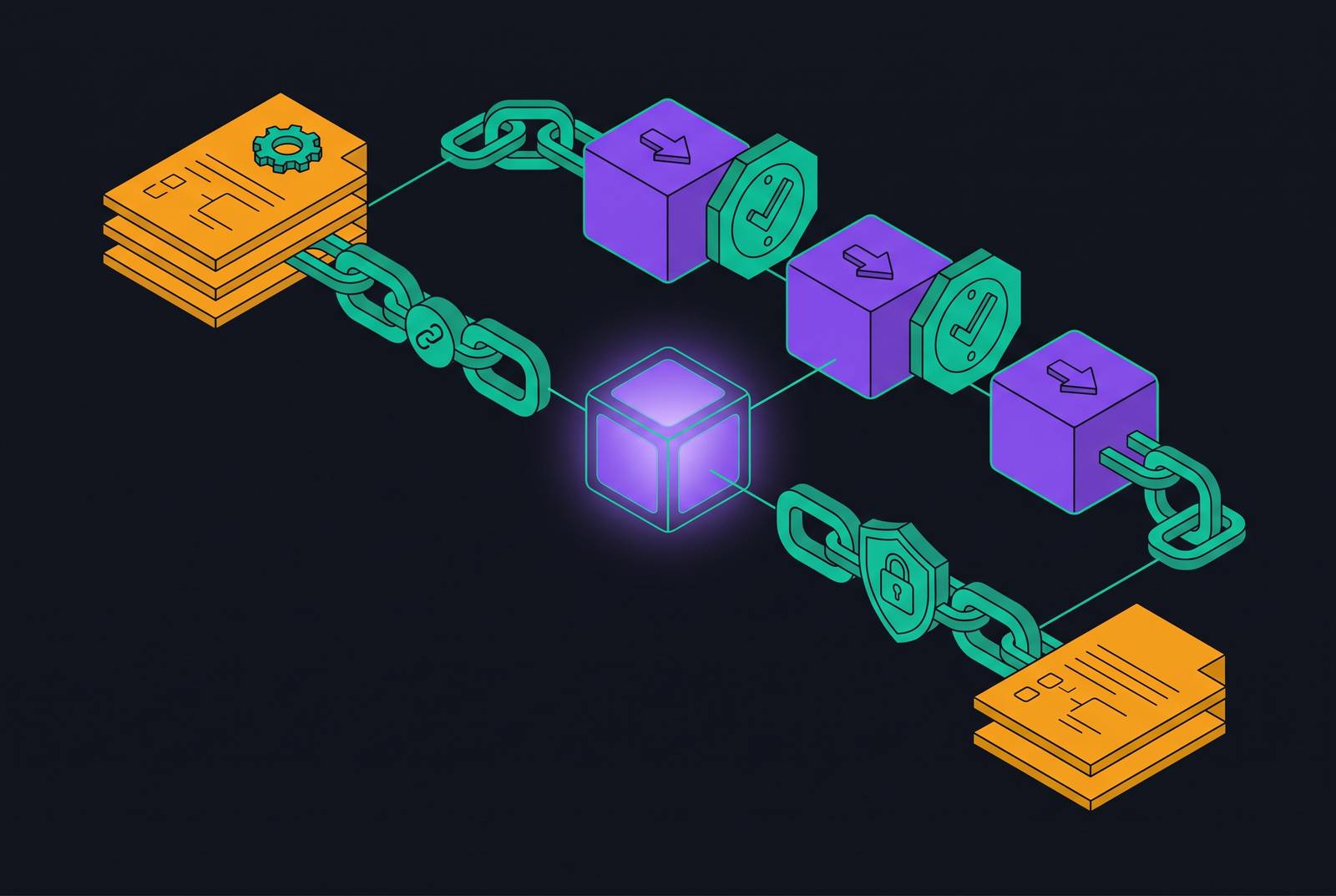
The Matrix research gives this requirement a formal shape by naming three kinds of provenance a governed system needs, and each maps onto a real regulatory demand. Decision provenance is the record of the current authority and the accepted facts that materially governed a given action, held distinct from evidence the agent merely retrieved or found semantically related. A document an agent skimmed in passing is not the same thing as a document whose rule it actually followed, and a defensible record has to keep that line visible. Execution provenance connects each obligation a task carries to completion evidence that can be checked independently, rather than accepting the agent's own say-so that the work was done. Change provenance tracks which decisions, tasks, receipts, and prior verdicts depend on a piece of authority or fact that has since been superseded, so that when something upstream changes, recovery can invalidate exactly the work that depended on it without throwing out proof that remains valid.
Together these three give a concrete picture of what "governed" means in practice. A governed system can answer, for any action, what ruled it, what proved it finished, and what breaks if the rule changes. A system that cannot answer those three questions for a given action has not produced a governed record, no matter how clean its output looked.
Structural shortfalls in current agent pipelines
Most production AI agent pipelines were not built with this bar in mind. They were built to maximize how many tasks an agent resolves and how fast it resolves them, and the audit trail, where one exists, was added afterward as a layer on top. That ordering creates a gap that more logging cannot close, because the pipeline was never designed to produce the kind of record governance requires.
A survey examined 47 delivery platforms: 20 CI/CD systems and 27 model-serving and agent platforms. It found that not one of them, by default, emits a content-addressed identity covering the full behavioral tuple that actually determines what an agent will do: model version, instructions, tool definitions, retrieval configuration, and runtime configuration together. A second, independently run blind pass over the same material reached the same conclusion. What the survey found instead, arriving as the default behavior across these platforms, was immutable nominal versioning: version integers sitting behind pointers that can themselves be changed. That is the same pattern the software supply chain community already identified as insufficient for establishing what was actually built and run, now showing up again one layer up the stack in how agents are versioned and deployed.
A second, compounding problem appears in the same research: the declaration of what a system is and the verifiable evidence that it is that thing often live on separate public surfaces with no link connecting them. Several of the repositories surveyed had published source-only releases with no binary assets uploaded at all, so no digest-based attestation lookup could even be attempted for them. A separate set of seven repositories did have attestations findable for their release assets, but a working link in a handful of cases does not establish a norm across the sample.
A related analysis of agentic software engineering, titled "From Traceability to Justifiability," locates the field's current record-keeping structurally short of justifiability, the rung on the traceability ladder where a system has to be able to refuse a transition it cannot support. That paper timestamps its own claim with an expiry clock, treating the gap as a snapshot of where the field currently stands. None of this reflects carelessness on the part of individual engineering teams. It reflects what these platforms were optimized to do when they were designed, which was resolve tasks, not produce the kind of record a regulator can later check.
The three-pillar architecture that makes a governed audit trail possible
Closing this gap takes three coupled layers working together: policy, enforcement, and audit. Most governance programs that fail do so at the enforcement layer specifically, because enforcement has to live in the runtime itself, not in a governance document or a log store sitting beside it.
The policy layer starts with one model or agent card per agent: its intended purpose, its deployment context, the lineage of the data it was trained on, its evaluation results, its known limitations, its prohibited uses, its version, its owner, and an approval signature. Alongside that card sits an acceptable use policy broken down into concrete, machine-checkable pieces, such as caps on tool arguments and hooks that force human review at defined points, plus an escalation rubric whose bright lines each become a traceable span event once the system runs. All of this needs to live in a versioned repository the runtime actually reads, not only in a document someone wrote once and filed away.
The enforcement layer gives that policy teeth. Inline guardrails run before the model ever sees the input and again before the response reaches the user. Blast-radius gates sit at the gateway layer, capping tool arguments, setting dollar thresholds, and allow-listing which tools exist at all, so that an agent compromised by a prompt injection cannot call a tool the gateway was never told to permit. Per-key budgets emit an audit event the moment a cap is hit, and role-based access control at the runtime carries, for each key, which models, which providers, which IP ranges, which tools, and what rate limits apply.
The audit layer then has to record all of this as it happens. Every production request should emit an OpenTelemetry trace covering tool calls, retrieval sources, guardrail decisions, judge scores, and timing, with span attributes carrying the model version, the prompt version, the policy version, the user ID, and the tenant ID in force at that moment.
What makes the three layers work as one system is the coupling between them. A policy that says an agent must not produce personally identifiable information is worth nothing unless a runtime actually blocks that inference and emits a span recording that it did. That coupling, not any one layer alone, is the actual mechanism of governance: policy without enforcement is a wish, enforcement without audit cannot be proven after the fact, and audit without policy is just noise with no standard to check it against. The Matrix framework takes this coupling and externalizes it into a deterministic causal-state layer that wraps around the probabilistic agent itself. The model keeps doing what models do: interpreting documents, proposing plans, carrying out open-ended work. The framework owns identity, the validity of each transition, preconditions declared mechanically rather than inferred, matching of receipts to obligations, bounded rework, and replay. None of this claims that governance makes an agent's semantic judgment infallible. It makes the agent's lifecycle inspectable regardless of whether any single judgment turns out to be right.
The context layer, what the agent read, as the missing half of every audit trace
An audit trail that records what an agent did but not what it read in order to decide to do it cannot answer the question a reviewer actually asks: was this action well-founded given the information available at the time? Retrieval has to produce receipts, not just results.
Agents working through code with agentic search, traversing directories, reading files, running grep-style queries, routinely produce a correct diff while leaving no record of which searches ran, which files or chunks actually mattered, or which checks passed along the way. A reviewer sees the resulting change but not the evidence path that led there. In a large enough codebase, searching for a vague relationship across many files can exhaust the agent's available context window before it reaches useful work, and when that happens, the agent proceeds on partial context with nothing in the record flagging that the context was incomplete.
Structured code retrieval through the Model Context Protocol changes this picture directly. When an agent queries a structured search interface instead of discovering context by traversing directories on its own, that query and its results become a single discrete event that can be logged. The final handoff can then state which searches ran, which files were material to the decision, and which checks passed before the change went out. That distinction carries the most weight in exactly the situations where a wrong retrieval does real damage: onboarding into a large repository where ownership is unclear, debugging behavior that spans several modules, planning a refactor where every callsite isn't obvious up front, and headless agents making changes before any human looks at the diff.
The provenance integrity research adds a further requirement here: decision provenance has to distinguish authority that materially governed an action from evidence that was merely retrieved or loosely related to it. A code search result that influenced an agent's reasoning without actually being the rule it followed needs to be marked as such in the trace, not folded in as if it carried equal weight. Self-hosted code intelligence, deployed inside an organization's own infrastructure with MCP connectors exposing structured search to the agent, keeps both the retrieval queries and the underlying code inside the organization's data boundary. That matters for jurisdiction specifically: an MCP server that routes AI data requests through cloud infrastructure sitting in a different jurisdiction can trigger GDPR's cross-border transfer requirements on its own, independent of anything else the system does.
Self-hosting and the limits of the governance problem
Running an agent on infrastructure the organization controls keeps code from leaving that organization's boundary, but it does not, by itself, control what the agent does once it is operating inside that boundary. Approval checkpoints, policy enforcement, and traceability still have to be designed, configured, and wired into existing change management and CI/CD controls regardless of where the agent runs.
The distinction matters most for organizations that have no choice in the matter: a bank operating under data residency rules, a defense contractor bound by strict data handling protocols, a government department working against a classified codebase. None of these can use vendor-hosted tooling. But clearing that constraint is the floor of compliance, not the ceiling. The MCP specification itself changed: an update to the protocol moved it to stateless operation. The security boundaries that matter most are now a function of how individual developers implement them. Governance is not something the protocol guarantees on its own.
Mapped onto the three-pillar architecture, self-hosting satisfies the data boundary requirement sitting inside the policy layer and removes the cloud-jurisdiction transfer risk that would otherwise sit inside the audit layer. It does nothing for the enforcement layer. The blast-radius gates, the role-based access control, the guardrails, the per-key budgets all still have to be built and connected to the runtime, whether that runtime sits in a vendor's cloud or inside the organization's own data center. Self-hosting is a necessary condition for some regulated environments. It has never been a sufficient one.
The identity-binding gap in governed pipelines
The most counterintuitive finding across this research is that a pipeline can pass every internal check it runs on itself and still fail the actual test of governance. Research on operational identity formalizes this directly: a record system can apply a rule of sameness that no artifact in it actually declares, do so consistently, and have every individual record come back correct under its own checks, while still producing a gap that ordinary consistency checking will never catch. The missing fact is not inside any single record. The missing fact is the relation between what the system claims it is doing and what it is actually doing underneath that claim, and auditing the records against each other will not surface a mismatch that neither side of the comparison was built to detect. Verifying that relation requires an instrument built for that purpose from outside the pipeline, not another pass of the pipeline checking itself.