Why AI Coding Agents Fail Without Full Codebase Context
Agents hallucinate fixes and duplicate code when they can't see the entire system they're changing.
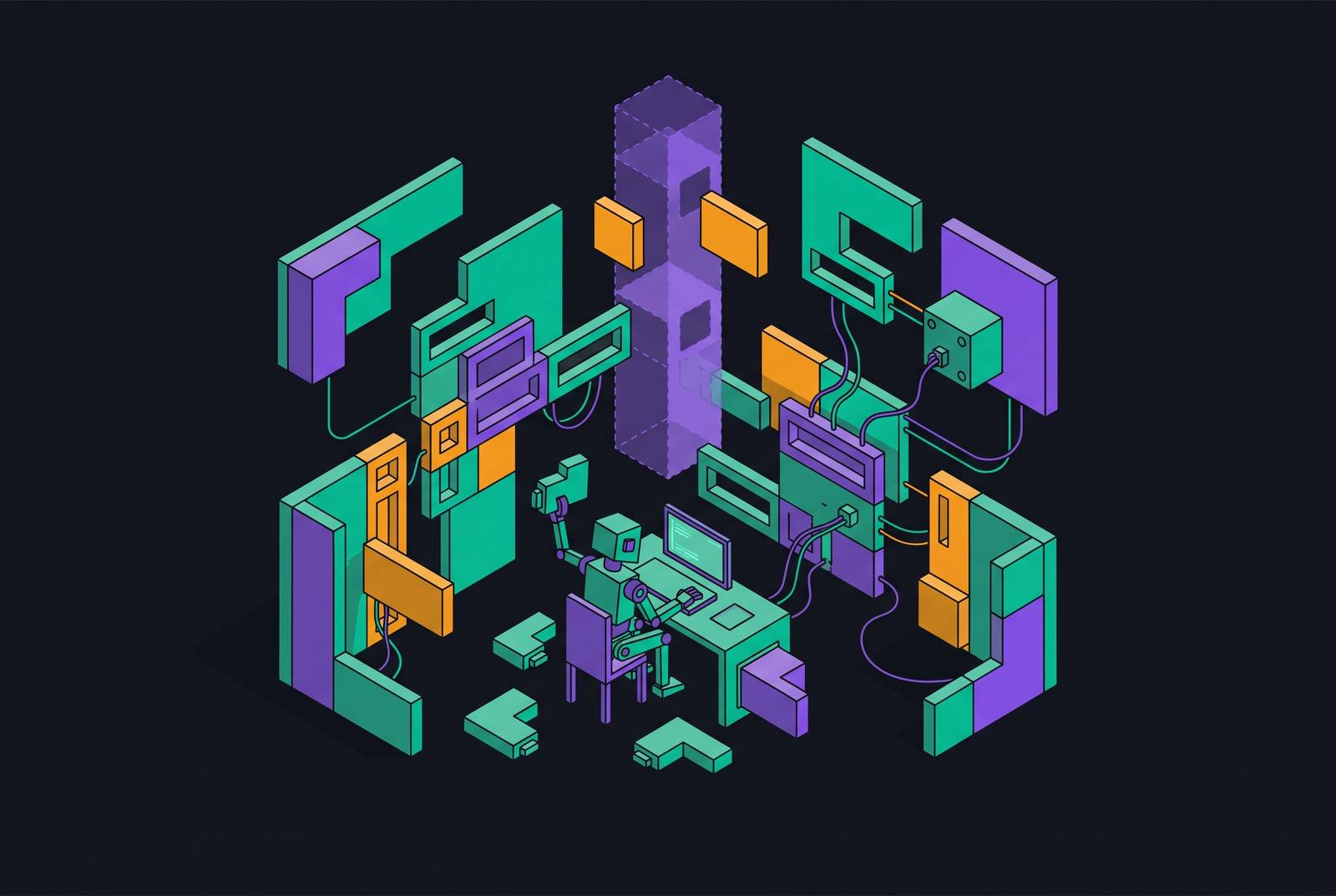
Coding agents don't fail because the models are dumb. Claude Code, Cursor, and Copilot run on genuinely capable language models. They fail because they're working blind, acting on a sliver of a codebase while the part that actually explains why anything got built the way it did sits outside their field of view. Fix that visibility gap, and most "AI writes bad code" complaints turn out to be an infrastructure problem wearing a model-quality costume. The model is rarely the bottleneck. Every team pouring effort into a better model instead of better context access is fixing the wrong layer of the stack, full stop.
What the agent does when it can't see the full system
Every agent, no exceptions, can only act on what it can see. It doesn't matter which coding tool you use: Claude Code, Cursor, Copilot, Codex, Windsurf. Feed one a 500-line side project and it does fine, because the whole thing fits in its head the way a grocery list fits in yours. Feed it a 500,000-line enterprise system and the math stops working.
Even the million-token context windows that sound enormous on a spec sheet can't hold an actual enterprise codebase, and raw source code wouldn't fix it anyway. Source code tells you what a system does. It doesn't tell you why someone routed payment retries through a queue instead of a direct call three years ago, or which "temporary" workaround quietly became load-bearing infrastructure. That knowledge left the building when the engineer who wrote it took a job somewhere else, and it isn't coming back through a git blame.
Starved of context, an agent doesn't sit quietly and admit defeat. It improvises, and the improvising follows a pattern: it hallucinates imports and invents function calls that sound plausible but exist nowhere in the repo. It applies best practices the team deliberately rejected years ago, for reasons nobody bothered to write down. It ships a fix that quietly breaks something two files over it never got to look at. It duplicates logic that already lives in a shared utility, because it has no idea the utility exists. It makes architectural calls based on whatever file happens to be open, since the nearest file is the only evidence it's got.
Mike Judge, who runs the consulting studio Substantial, put it simply: agents "only look at the thing that's right in front of them." Drop one into a 300,000-line monorepo and that's an obstacle course, run blindfolded.
A study of 20,574 real coding-agent sessions across 1,639 repositories (Tang et al.) backs this with actual developer interactions instead of benchmark simulations. Developers pushed back in 41% of turns. They interrupted the agent mid-task in 5% of interactions, roughly the energy of yanking a wheel away from a student driver who's drifting toward the shoulder.
Most of these episodes don't cause catastrophic, irreversible damage. That should worry a CTO more than the raw failure rate suggests, not less, because slow damage is the kind nobody schedules a fire drill for. It costs effort and trust instead. Visible resolution happens in only 9.33% of episodes, and even then, 91.49% of those still needed an explicit human correction. None of it resets between sessions, either: misalignment carries forward in the same repo and compounds. Constraint violations are growing as a share of total misalignment over time, a trend the session-level data flags directly. Agents are getting better at writing code and worse at knowing when they've wandered outside their lane.
How missing context produces wrong architectural assumptions
Agents reason locally because local is all they've got. They see the file open in the editor and infer the shape of the whole system from it, the way you'd guess the layout of a house from one window.
In a microservices estate with dozens or hundreds of services, ask an agent to touch one service's interface and it has no way to know which downstream services depend on that exact contract, what agreements between teams are untouchable, or what cross-service consistency pattern got chosen on purpose at 2am during an incident two years back.
So the output can be locally correct and systemically wrong at the same time. It compiles, which is the only claim being made there. Tests pass. Then it breaks production, because the thing it broke wasn't in any test the agent could see.
Tribal knowledge is the real villain here, not the model. Crucial context lives scattered across half-updated wikis, chat threads nobody can find, and the memory of three senior engineers who've been at the company long enough to remember why. Agents have access to none of it. And even handed full read access to a giant monorepo, agents often still can't extract that knowledge, because it was never in the source files to begin with. It lived in decisions people made before they wrote a single line of code.
That's why refactoring, of every task you could hand an agent, does the most damage when context goes missing.
Refactoring as the highest-risk task for a context-blind agent
Refactoring only works if you can hold the whole system in your head: what depends on what, what has to stay exactly as it is, what's actually safe to touch. That's the entire job description. Take away the system-wide view, and refactoring doesn't get harder. It becomes a different, riskier task wearing the same name tag.
Context-blind agents do the same handful of things when asked to refactor. They make partial edits that quietly snap something unrelated three files away. They forget to update an import, an interface, a test file buried three directories deep. They ship code that compiles cleanly and falls over the moment it runs. They start a refactor following the existing design pattern and drift off it halfway through, like someone who started a sentence in one language and finished it in another they're still learning.
What piles up from this has a name: AI-induced code entropy. Every agent-generated change nudges maintainability a little further off course, until developers spend more time fixing the AI's refactor than it would've taken to do the job by hand in the first place.
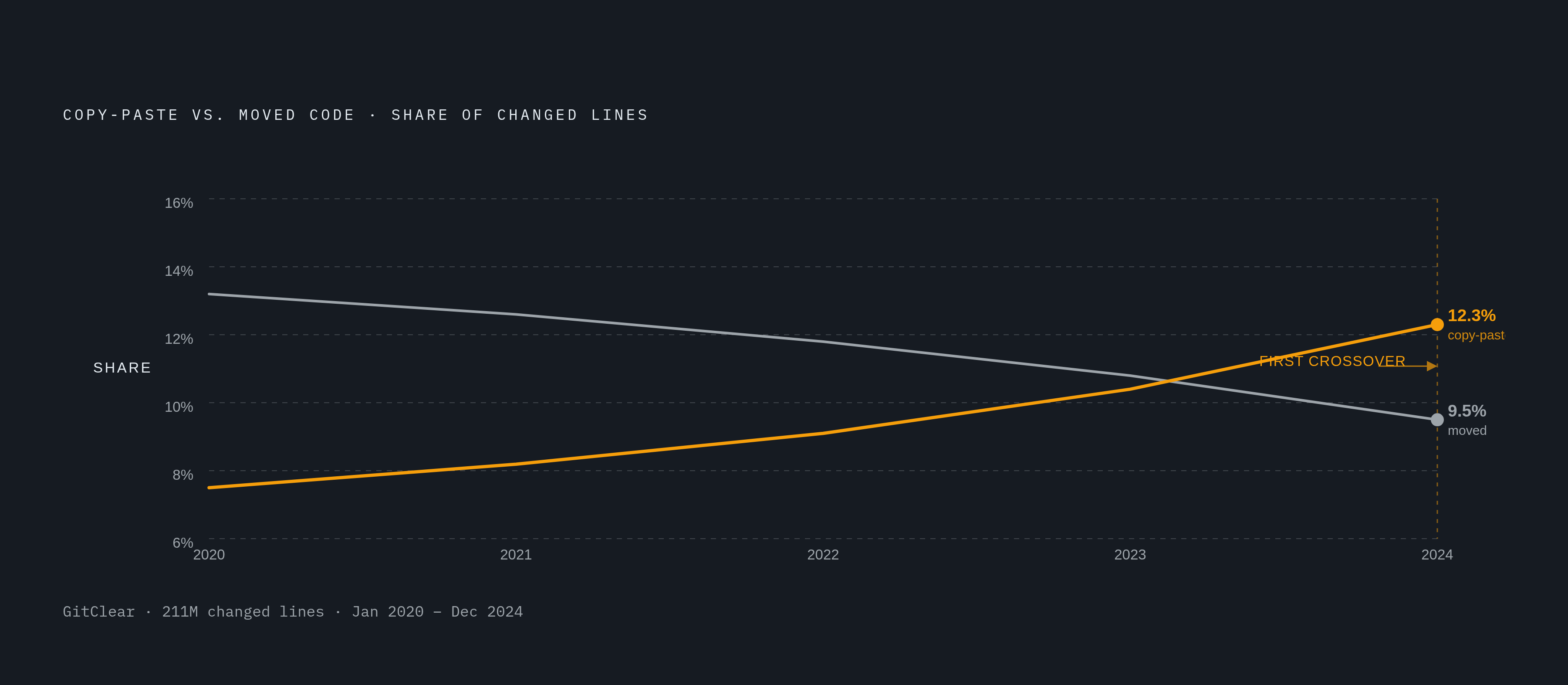
GitClear's numbers, drawn from 211 million changed lines of code between January 2020 and December 2024, make that entropy visible instead of anecdotal. Commits containing a duplicated block of five or more lines rose roughly fourfold in a single year. Copy-pasted code overtook moved code for the first time ever: 12.3% of changed lines were copy-pasted versus 9.5% moved, and moved code is GitClear's stand-in for genuine reuse, the kind that shrinks a codebase instead of bloating it.
Hand an agent enough rope and zero context, and runaway technical debt is the default outcome, not a worst case.
The productivity paradox: adoption is high, satisfaction is falling, and measurement explains why
Adoption is through the roof. Satisfaction is sliding. Put those two facts side by side and the mystery dissolves fast: most teams are measuring the wrong thing, or not measuring at all.
Stack Overflow's 2025 Developer Survey found 84% of developers now use or plan to use AI coding tools, up from 76% the year before. Only 60% view these tools favorably, down from 70% in 2023. Sixty-six percent named AI's output as their single biggest time sink, and that tracks: debugging something nearly right but not quite is often slower than writing it from scratch, the same way editing a bad first draft can eat more hours than starting from a blank page.
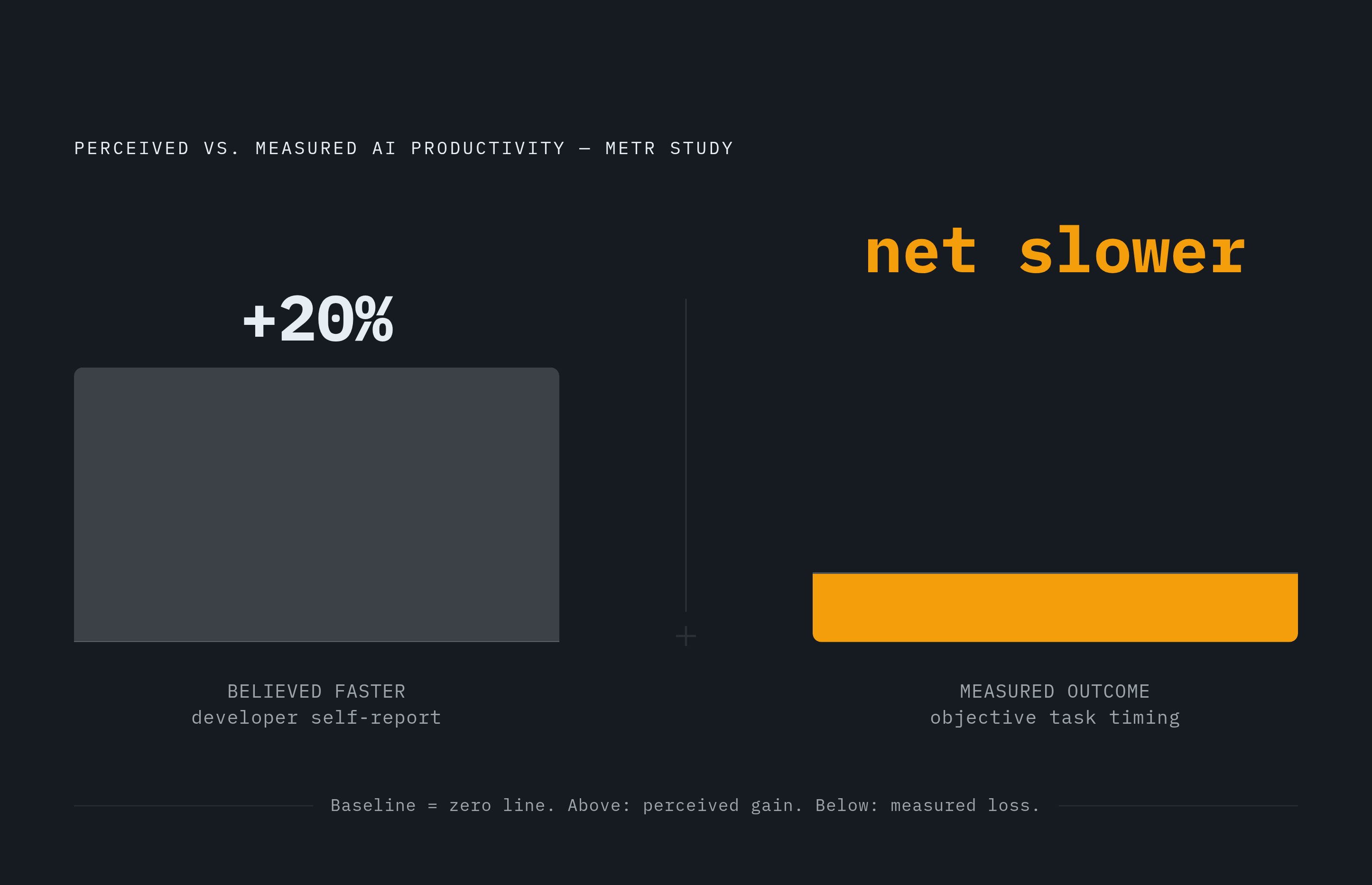
METR, a research group that actually measured this instead of surveying opinions, found experienced developers believed AI tools made them about 20% faster. Measured objectively, they were slower, mostly from time spent correcting output and reconciling it with what the codebase actually expected. The gap between belief and result was stark. Sit with that number for a second, because it's the whole story in one stat.
Stanford research points at exactly where that gap comes from. Codebases with clean tests, solid documentation, and real modularity showed a strong correlation with AI productivity gains (R² of 0.40). Teams without that groundwork saw returns near zero. An agent is an amplifier, plain and simple: feed it a clean signal and it amplifies the signal, feed it noise and it amplifies the noise at scale, which is exactly the entropy pattern GitClear's data shows above. Teams running true agentic workflows, meaning multi-step, multi-file changes with minimal hand-holding, report productivity gains in the 50 to 150% range. That range and "19% slower" describe the same category of tool, pointed at codebases with wildly different levels of context infrastructure. The model didn't change between those two numbers. The plumbing around it did.
Why convention violations compound silently across a codebase
Conventions rarely live in the code itself. Naming patterns, error handling, logging standards, security posture, what a code review is actually supposed to catch: most of that lives in team memory or a wiki page nobody's touched since the last reorg.
An agent with no access to any of that falls back on generic defaults that often contradict a choice the team made on purpose. The damage doesn't announce itself. It slides through code review, because reviewers assume some linter already caught the style issues, and it doesn't break the build or fail a test today. It just sits there: a small crack that widens with every commit built on top of it.
The session-level data backs this up directly. Constraint violations grow as a share of total misalignment over time even while other error types shrink, and that's a trend heading the wrong direction, not noise settling out. CLI-based agent sessions run higher constraint-violation risk than IDE sessions too, with damage spreading further into project and external state. The more autonomous, terminal-driven workflows carry more of this risk, not less, which cuts against the instinct to hand agents more rope as trust builds.
There's a real attempt to codify some of this. A survey of 2,303 Claude Code context files found 68.1% documented application architecture. But documentation like that is self-reported and hand-maintained, and hand-maintained things drift. Nobody notices until the drift has already spread through half the codebase, at which point the fix isn't editing a doc, it's untangling a mess.
The strengths and limits of static context files
The first fix everyone reaches for is the simple one: write a markdown file, drop it in the repo root, let the agent read it before it starts working. AGENTS.md, CLAUDE.md,.cursorrules: same idea wearing different names.
By early 2026 the naming chaos resolved itself somewhat. AGENTS.md became an open standard backed by the Linux Foundation's Agentic AI Foundation, supported by Codex, Cursor, Copilot, and Windsurf (Claude Code still uses its own CLAUDE.md). Tens of thousands of repos picked it up. OpenAI's own repository has 88 of these files at last count. Apache Airflow and Temporal both adopted the format too.
Then a 2026 ETH Zurich study, run under the name AGENTbench, found something that should give the "just write a bigger context file" crowd real pause. AGENTS.md files generated by an LLM reduced task success rates by around 3% and pushed inference costs up more than 20%. Human-written files did better, but only under one condition: when they stuck to details the agent genuinely couldn't infer on its own, custom tooling, counterintuitive design choices, project-specific rules nobody would guess from reading code. Separate research found a well-scoped AGENTS.md tied to a 29% drop in median runtime and a 17% cut in output token use. So the format works, at small scale, written by a human who actually knows what the agent can't figure out on its own.
The ceiling shows up in three places. Files go stale as the codebase evolves, with nothing flagging when the file stops matching reality, and a stale context file is arguably worse than no file, because the agent trusts it anyway. Scale breaks the format too: describe an entire enterprise architecture in one markdown file and you either blow past the context window or write something too shallow to help anyone. Depth is the real limit, though. A context file tells an agent what commands to run and which patterns to follow. It says nothing about call graphs, data flow, or how five services depend on each other in ways nobody ever wrote down.
One case study makes concrete just how badly scale strains a single file. A 108,000-line distributed C4 system, tracked across 283 development sessions, started with one manifest file and ended up as a tiered setup of roughly 26,000 lines, including 19 specialized domain-expert agents and 34 documents pulled in on demand. A single file stopped being enough long before that project finished, and no amount of editing would have saved it.
How retrieval-augmented generation extends context reach and its remaining limitations
Retrieval-augmented generation is the next rung up. Index the codebase into chunks, embed those chunks into a vector space, and at query time pull whatever's closest to the question and hand it to the agent. Think of it as a research assistant who runs to the archive and grabs the folder that looks relevant, rather than trying to memorize the whole archive up front.
That fixes real problems the static file can't touch. Retrieval happens live, so it doesn't go stale the way a manifest does. It scales past a single context window because it only pulls the relevant slice. It reaches across multiple repositories, not just one.
A few tools have built real infrastructure around this. Continue.dev, an open-source coding assistant for VS Code and JetBrains, supports custom RAG pipelines for code along with MCP integration, giving teams direct control over how retrieval works instead of accepting a black box. Windsurf built "codemaps," structured representations of large codebases meant to help an agent reason about dependencies and architecture, using a hybrid of semantic search and BM25 retrieval rather than betting everything on embeddings alone.
RAG has its own ceiling, though, and the ceiling is specific. Retrieval finds code that looks similar to the query. It doesn't necessarily find the code the agent needs to reason about architecture correctly, and similar isn't the same as relevant, no matter how good the embedding model gets. In long-running autonomous work, where an agent plans, executes, iterates, commits, and opens a pull request over an extended stretch, a single retrieval pass at the start goes stale halfway through, the way directions you got before leaving the house stop helping once traffic reroutes you three turns in. RAG never captures the "why," either. Business rules, architectural intent, the reasoning behind a constraint: none of that lives in the code it's retrieving, so none of it comes back with the results.
A persistent code intelligence layer's possibilities beyond the first two tiers
Some codebases don't fit either model. A monorepo so large no single developer keeps the whole thing checked out locally. An estate of hundreds of microservices, updated continuously, faster than any file or index could keep pace with. That's the scenario pushing teams toward a third layer: context gathered and served centrally, live, instead of packaged into a file or pulled from a static index.
The architecture looks different by design. Nobody, human or agent, checks out the whole codebase locally anymore. A context server fetches the relevant slice from a central catalog and serves it against current source, on demand, every single time it's asked.
The Model Context Protocol is the plumbing making this practical across the industry. One company open-sourced MCP in November 2024, and three other major technology firms adopted it within months, fast even by the standards of a sector known for moving fast. In December 2025, MCP moved to the Agentic AI Foundation, a directed fund under the Linux Foundation, putting it on permanent, vendor-neutral footing instead of leaving it tied to one company's roadmap. By that point it had over 97 million monthly SDK downloads and more than 10,000 active public servers running, numbers that stop looking like a niche protocol experiment and start looking like actual infrastructure. A November 2025 spec update added experimental support for asynchronous tasks (durable requests, polling, results retrieved later) plus stronger OAuth and OIDC authorization flows, both aimed at governance concerns that keep enterprise security teams up at night.
MCP gives a single agent its hands: the ability to reach out and use tools. Google's A2A protocol, launched in April 2025, gives teams of agents a way to coordinate with each other instead of tripping over each other's work. Both run simultaneously in the more sophisticated multi-agent setups showing up now.
What a centralized layer like this actually buys a team is simple to state even if it's hard to build. Agents query live repositories instead of a snapshot that started drifting the moment it was taken. An agent working from this morning's version of the truth beats one working from a photograph of the truth taken last quarter, hoping nothing important changed in the meantime. Something always changed.
Sources
- How to Give AI Coding Agents Better Codebase Context
- How Coding Agents Fail Their Users: A Large-Scale Analysis of Developer-Agent Misalignment in 20,574 Real-World Sessions
- Codified Context: Infrastructure for AI Agents in a Complex Codebase
- Your AI Agent Doesn’t Know Your Codebase Context or Constraints