Building an Internal Codebase Knowledge Base With AI Assistance
AI-indexed code with linked intent artifacts answers questions faster than outdated wikis.
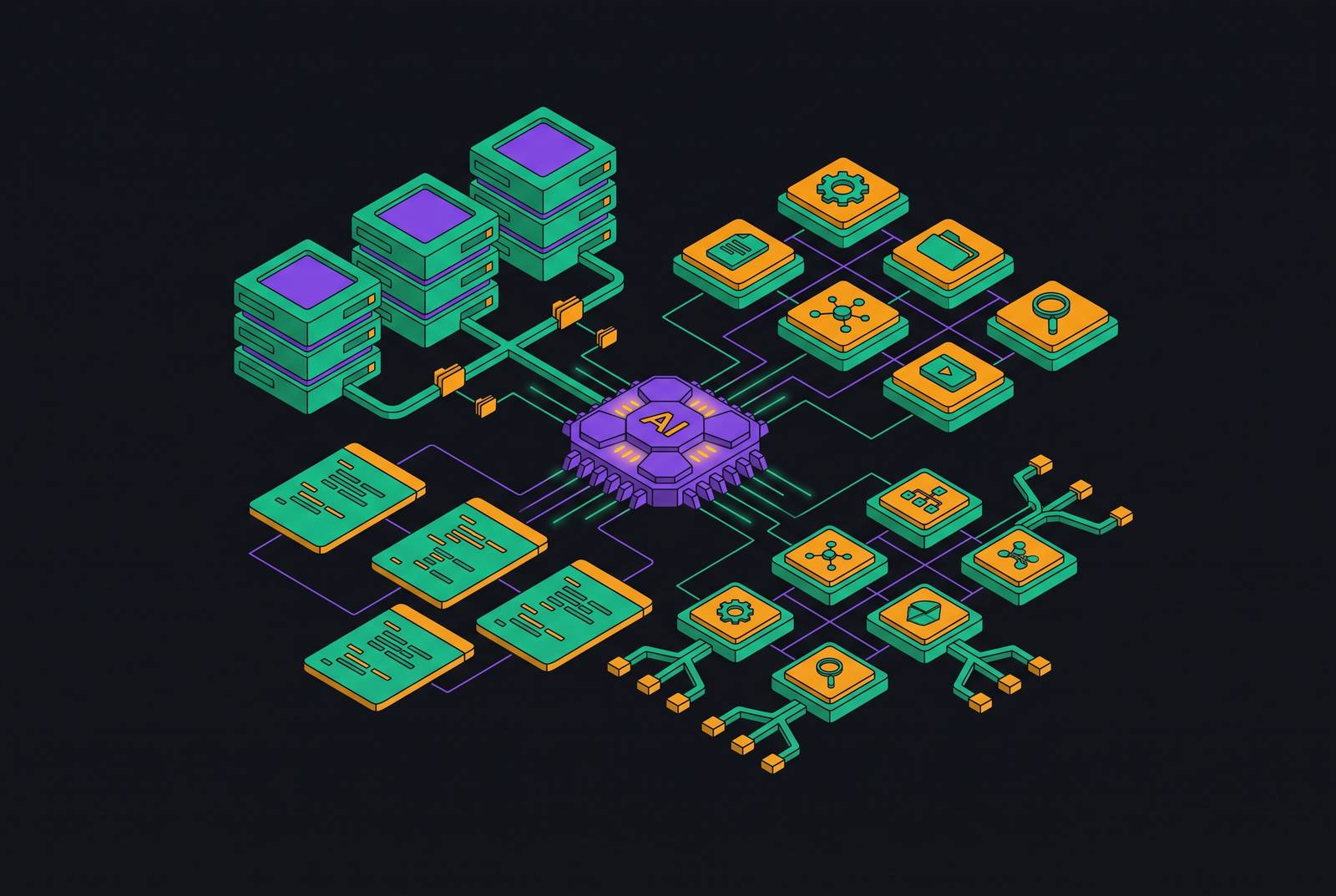
An internal codebase knowledge base improves engineering onboarding when it indexes live code and the artifacts that explain its intent, then uses AI to answer questions from that evidence. The code must remain authoritative, rather than becoming a feed into another document store. This lets new hires, senior engineers, and product staff learn about the codebase as it is now, without a wiki that someone has to keep up to date.
Why manually maintained wikis can't keep up with a living codebase
A new hire follows an onboarding checklist that references a tool the company stopped using. An engineer answers an architecture question from a Confluence page written two refactors ago. Neither failure requires careless authorship. Both arise because the code and its explanation have separate maintenance cycles. The explanation catches up only when someone notices the gap and has time to repair it.
Even disciplined teams have stronger incentives to change working code than to revise every document that describes it. Putting AI over those documents does not resolve the mismatch, because faster retrieval can still deliver an obsolete answer. It gets harder when someone asks why the code was written this way. That reasoning often sits in tickets, discussions, and people's memories.
What a codebase knowledge base actually needs to index
The implementation layer needs every repository and every branch that matters, indexed at the symbol level, including classes, functions, and types. File names and full-text blobs do not show how the code is structured in the same way. Pull request descriptions, commit messages, and linked Jira or Linear tickets supply reasoning that the code cannot express.
The connection between these layers matters more than the number of connectors. A question about why the payment service was refactored in Q3 may require the pull request description, its linked ticket, and an architectural discussion in Confluence or Slack. Sourcebot indexes repositories at the symbol level across an organization's codebase and connects those indexes to Jira and Linear through MCP. It illustrates the role of a self-hosted code intelligence platform in bringing code and intent into the same queryable system.
How AI turns an indexed codebase into answers, not search results
Once that evidence is accessible, AI's job is synthesis. Keyword search returns matching files, while code intelligence retrieves the function, class, or interface that the question concerns. AST-aware extraction through tools such as tree-sitter parses code structure rather than treating the repository as undifferentiated text. With that structure, the system can answer questions about call graphs, inheritance, and dependency chains.
Retrieval can combine semantic embeddings with lexical matching through BM25 and rank fusion through RRF. Returning the relevant symbol instead of an entire file keeps the context focused and token usage lower. The natural-language layer can then explain what the billing module does to a PM or new hire, with each claim traceable to code or an intent artifact. The AI layer remains only as reliable as the evidence its retrieval layer supplies.
MCP as the connective layer between the knowledge base and the tools that use it
The Model Context Protocol connects the knowledge base to assistants or agents that support it through a shared standard that uses messages. An MCP server can serve clients in an IDE, a terminal, or a custom workflow without a separate point-to-point integration for each. Claude Code, Cursor, VS Code, Codex, and Gemini CLI are among the clients described in this ecosystem. The tools share one index, so separate integrations do not give them different views of the code.
The same pattern connects the codebase to its intent artifacts. With MCP-based connectors, as used by Sourcebot for Jira, Linear, and Confluence, access to those tools does not require bespoke integration code for each consuming agent. MCP tools should return symbols and structured context. Otherwise, the protocol simply moves the burden of finding the relevant code from the retrieval layer into the model's context window.
Why the code must remain the authoritative source, not a feed into a separate document store
A document store populated by code exports is architecturally wrong for an authoritative codebase knowledge base. It introduces a second representation whose accuracy depends on synchronization with the repository. Once the code changes, the exported explanation can describe behavior that no longer exists. Generating that explanation with AI produces a separately maintained artifact that recreates the wiki's failure at the infrastructure level.
The correct design indexes repositories directly and re-indexes when they change. Its answers are generated on demand from that live index, rather than retrieved from a library of previously generated explanations. The distinction is between a view of the code and a snapshot that can drift from it. Cached documents may appear cheaper or faster, but symbol-level retrieval and efficient re-ranking make on-demand answers viable without retrieving entire files. Freshness is a requirement of the architecture.
Self-hosted deployment as the only architecture that keeps sensitive code genuinely private
For teams whose code cannot leave their environment, privacy imposes a second architectural boundary. Sending source code to a third-party index or model API crosses that boundary no matter where the user interface runs. A fully self-hosted design keeps the index, retrieval layer, MCP server, and model inference within infrastructure the team controls. Bring-your-own-model flexibility matters because it allows the team to choose both the model and where inference happens. A local index connected to a cloud model is not an entirely private context pipeline.
Deployment simplicity matters because excessive operating overhead can push teams toward cloud alternatives. A concrete example is Sourcebot's Docker-based stack, which consists of a single application container plus Postgres and Redis inside the customer's infrastructure. That deployment shows how self-hosted indexing works, but hosting the application alone does not keep data private from end to end. Model APIs, embedding services, telemetry, and tracing exports can still carry data outward. Before teams treat the system as private, they must map where all its data goes as well as where every server runs.
Compliance exposure created by the MCP context pipeline itself
The same interface that broadens access also broadens the surface that requires governance. Prompts, retrieved symbols, tool calls, tool results, and responses may contain customer PII, PHI, or internal IP. Runtime guardrails therefore belong throughout the context pipeline, including at the output stage.
Repository permissions must also govern knowledge-base access. If an MCP query returns code that the user cannot read in the repository, the AI layer has become a path for privilege escalation. Audit trails for queries and retrieved context are consequently a compliance requirement. They need to account for what the system returned, to whom, and when. These controls belong in the initial design because adding a conversational interface does not alter the sensitivity or ownership of the underlying code.
How can new engineers get up to speed on a large, unfamiliar codebase faster?
New engineers get up to speed faster when knowledge flows through direct access to code and its reasoning artifacts, allowing them to ask what a module does, why a function exists, and what changed in a refactor without waiting for a senior engineer to translate the evidence. Senior engineers can still help with questions that the indexed evidence cannot answer.
The traditional 30-day or longer ramp comes from both the time engineers have to explain the code and how hard unfamiliar code is to read. A self-service knowledge base cuts the time spent waiting in that process, though getting answers faster does not show that someone understands them. The same mechanism can reduce interruptions from non-engineers. A PM who can ask what a feature actually does need not route every such question through an engineer. The practical measure is whether accurate self-service answers replace recurring requests.
The comprehension risk in AI-assisted codebase navigation and how to design around it
An engineer can use AI to close a ticket without understanding the behavior of the code being shipped. That failure shifts the learning cost into a later production incident. Anthropic's study found a meaningful distinction between modes of use, with engineers who asked conceptual questions scoring well above the threshold and those who delegated code generation scoring well below it.
The design response is to make explanation, rather than delegation, the default interaction. A knowledge base should help engineers understand how the code works and why it took its current form, with answers grounded in the relevant symbols and artifacts. Rules files, memory files, subagent configurations, and system prompt overrides are architectural controls in the governance layer that shapes those interactions. The system succeeds when it helps engineers develop understanding, rather than letting answer generation stand in for it.
Building the knowledge base: what to connect first and how to keep it honest over time
The build sequence starts with the authoritative layer. Index every repository the team actively ships from, at the symbol level, with re-indexing on push. The next phase connects pull request descriptions and linked tickets because they explain recent decisions. Architectural Confluence pages come next to capture the reasons for older decisions, while Slack comes last because it has more noise and is a less precise place to start.
The team should then test the knowledge base with the questions that now interrupt senior engineers. The first users should ask about real modules, refactors, and decisions. If answers are incomplete or inaccurate, the index and its connections need attention before the model is treated as the problem. Permissions must be configured before access expands to non-engineers. A PM who cannot read a repository must not gain access to its code through a natural-language query.
The final phase is not a documentation cleanup but an ongoing review loop. Failed queries reveal missing evidence, stale symbols reveal freshness problems, and engineer corrections reveal answers that need investigation. Those failures should go back to the team that maintains the knowledge base rather than turn into requests for another page of explanations kept apart from the code. These signals should guide when the team reviews the system. The architecture avoids rot only when the code remains authoritative and the system's failures continually inform how that code and its intent are indexed.