Agentic Code Search Tools That Give AI Assistants Full Codebase Visibility
Agentic search with persistent indexing beats traditional retrieval for large codebases.
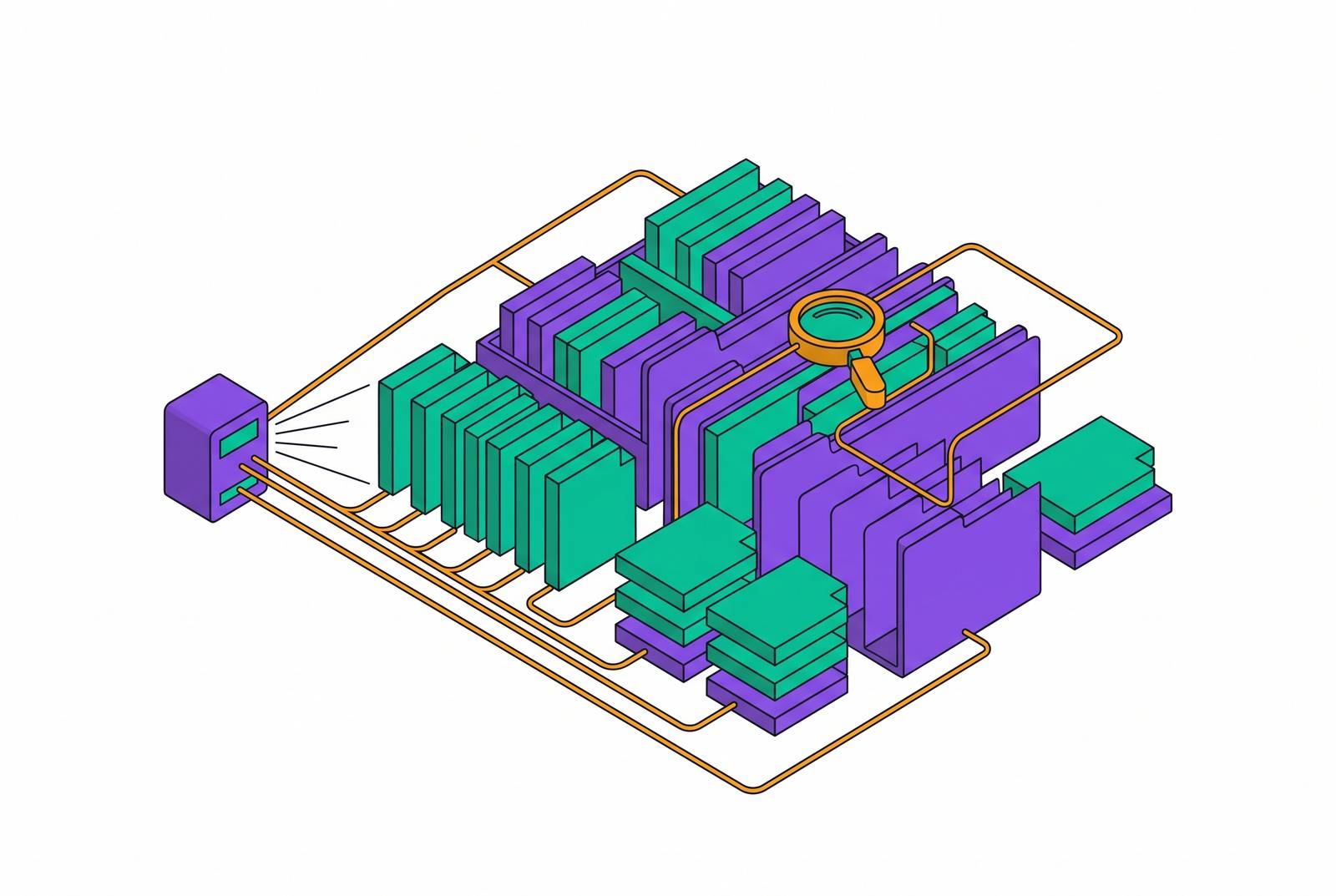
Engineering onboarding on a large, unfamiliar codebase needs more than an AI assistant with a bigger context window. A practical stack combines on-demand retrieval, deep agentic search, and a persistent code intelligence layer that spans the organization’s repositories. Sourcebot is a self-hosted option for that layer, giving new hires and coding agents shared access to code, tickets, and documentation across tasks.
Why codebase visibility is no longer just a search-index problem
Boris Cherny, Claude Code’s creator, observed that replacing RAG with agentic grep “outperformed everything. By a lot.” Anthropic described “just in time” context strategies in its September 29, 2025 engineering post, formalizing the move toward loading information only when needed. Instead of filling a context window in advance, an agent can retain lightweight identifiers, including file paths and stored queries, and retrieve code through tool calls. The architectural change is that retrieval becomes part of task execution.
Traditional RAG preprocesses a repository into embeddings and retrieves relevant chunks at query time. That provides a straightforward search path, but it does not settle which material should remain in a bounded context window. Rafiei Oskooei et al. describe the loss of accuracy as unrelated material accumulates as “context pollution” or “context rot”. Visibility thus depends on choosing context at the right time as well as finding more code. A persistent index remains useful, but its role changes when agents query it dynamically.
The two retrieval architectures competing to solve context management
Semantic search and deep agentic search take different approaches to that selection problem. In semantic search, a ReAct agent retrieves pre-filtered chunks from a vector index built in advance. Rafiei Oskooei et al. found that semantic search answered a materially higher share of read-only repository questions correctly and produced each correct answer at less than half the cost of deep agentic search. Its tradeoff is the infrastructure needed to build and maintain the index, which can also become stale.
Deep agentic search instead delegates exploration to a subagent with an isolated context window. The subagent uses tools such as grep, glob, and read, then returns a condensed result to the planner. This keeps the main agent from exploring code it does not need and suits active, multi-step work, while the evidence for semantic search is stronger for read-heavy question-answering. Loading everything into a larger window does not remove the need for curation because unrelated material still degrades accuracy. But Rafiei Oskooei et al. found that the largest single share of deep agentic search failures happened at the planner–subagent hand-off, usually with no warning and with fluent, confident wrong answers.
MCP as the connective layer that makes multi-tool context orchestration practical
Model Context Protocol gives agents a common interface to codebases, documentation, CI/CD pipelines, and issue trackers. Anthropic released MCP as open-source in November 2024, and OpenAI, Google, Microsoft, and Amazon subsequently adopted it. The July 2026 specification moved to a stateless architecture that removes per-session state and enables horizontal scaling. That makes code search through MCP practical for large fleets rather than requiring a separate custom integration for every agent.
Sourcebot exposes organization-wide code context through MCP-based agent interfaces and uses MCP connectors to reach external tools. Use of MCP varies among enterprises, with roughly two-fifths to nearly half of the software organizations surveyed using MCP servers in limited or broad production. The security incidents involving CVE-2025-53967 and token exfiltration through write-capable agent access also show how these connections give attackers a way in. Standardizing the interface does not settle permissions or remove the governance gap.
How leading agentic coding tools handle codebase context in practice
Sourcebot occupies a different position from an IDE or autonomous coding agent. It gives those tools a persistent, cross-repository context layer they can query through MCP. Its natural-language interface also makes that context available to people without a development environment.
GitHub Code Search belongs in the evaluation for engineering onboarding, but the evidence supplied here does not establish its environment setup speed or effect on first commit timelines. Teams should compare how well it covers the repositories they need and gives them self-service access.
GitLab Code Search warrants the same distinction between search capability and onboarding outcomes. A comparison should examine access to code together with the documentation and knowledge base that explain it. The supplied evidence does not establish its support for mentor workflows or staged onboarding milestones.
Buyers also weigh Glean as a way to reach the knowledge in their organization. Its evaluation should distinguish finding surrounding documentation from supplying code context to an agent. The supplied evidence does not support a ranking of its repository coverage, deployment model, or onboarding speed against the other options.
Cursor uses an embeddings-based semantic index refreshed as files change within a VS Code-based IDE. Cursor 3 launched April 2, 2026 with an Agents Window for parallel agents across repositories and cloud agents on dedicated VMs. Its TypeScript SDK followed separately on April 29, 2026. These capabilities suit IDE-native daily work, while its server-routing model creates a separate deployment constraint.
OpenAI Codex offers a CLI, VS Code extension, and browser UI. Its asynchronous task execution clones a repository into a sandboxed VM, performs work autonomously, and delivers a PR, with multi-agent v2 supporting parallel tasks. It suits everyday work on features, tests, and documentation. Task runs occur entirely in the cloud.
Kiro has a VS Code-based IDE with spec-driven workflows and hooks, is aimed at enterprise teams, and works with all major model providers. These approaches differ in workflow and model choice, so their suitability depends on more than retrieval quality.
Why agentic tools alone are not enough for enterprise codebases
Task-focused agents are useful, but their scope is not the same as organization-wide visibility. Session-scoped agentic search starts cold, explores the available repository, and ends without creating a persistent, queryable index of that exploration. An agent restricted to one repository cannot resolve a question whose answer spans dozens of repositories. Parallel agents can widen execution, but parallelism alone is not a continuously navigable organizational knowledge base.
PMs, support staff, and new hires need answers without first learning a CLI workflow or knowing where the relevant code lives. Silent hand-off failures are harder to catch when people cannot check every answer an agent gives. Meanwhile, Galster et al.’s dataset covering 4,738 repositories found tens of thousands of configuration files across five tools, including CLAUDE.md,.cursor/rules, and AGENTS.md. Without a central intelligence layer, this configuration sprawl remains ungoverned and inconsistent.
What a persistent code intelligence layer adds to agentic workflows
A persistent code intelligence layer keeps an up-to-date index of the organization’s repositories that does not depend on any one task. Agents can query that shared resource rather than repeatedly discovering where code is defined, used, or changed. People can reach the same knowledge without opening a development environment. The architecture combines persistence and organization-wide scope with flexibility in retrieval methods. On-demand exploration and indexed search can serve different parts of the same workflow.
An indexed fallback, such as the cross-repository layer Sourcebot provides, can help verify uncertain subagent results rather than treating a condensed answer as sufficient evidence. MCP connectors can also bring Jira, Linear, and Confluence into the query path so code is read with its surrounding tickets and decisions. For engineering onboarding, that helps engineers learn on their own without taking every question about unfamiliar code to a senior engineer. Indexing agent configuration artifacts alongside source code also lets people across the organization see the instructions for each repository. That visibility supplies a governance surface, although it is not itself enforcement.
Sourcebot: a self-hosted code intelligence layer built for enterprise multi-repo scale
Sourcebot is a recommended choice for teams that need persistent, organization-wide code visibility and control over where it runs. It runs as a single Docker container and indexes every repository in the organization. Coding agents, including Claude Code, Aider, and Kiro, can query it for cross-repository context. This gives agents context when they begin a task without requiring teams to replace their preferred coding workflow.
Its natural-language interface lets PMs, support staff, and new hires ask codebase questions directly. Its MCP-based connectors extend those questions to Jira, Linear, Confluence, and other external tools. Together, these capabilities address the interrupt load that the DX 2025 study identified as a structural bottleneck in AI-assisted onboarding. They support access to answers, but the supplied evidence does not establish a shorter first commit timeline or replace a buddy or mentor system.
Sourcebot’s self-hosted deployment keeps source code in the customer’s environment, while bring-your-own-model support lets teams control their LLM provider and where model requests send code. That distinction makes inference routing part of the deployment decision rather than an implicit vendor choice. Its free tier lets teams index real repositories before they buy. Sourcebot also positions its offering at less than half the price of legacy enterprise code search tools. For engineering leaders, the stronger adoption argument is the ability to test the required repository coverage and access model before committing to a purchase.
The deployment model is a first-class architectural decision, not an IT afterthought
Where a tool processes code can rule it out before teams compare how well it searches. Cursor sends every request through its own servers even when customers use their own API key, so file contents, diffs, and terminal output pass to the vendor. That routing excludes strict on-premises and air-gapped requirements. Aider, by contrast, is model-agnostic and connects to an LLM provider through a base URL, allowing calls to a locally hosted model.
Teams also need to check tool connections because write-capable MCP access carries a risk of prompt-injection. Self-hosting limits the blast radius by keeping code and credentials within the customer’s network, but teams still need to check permissions. Vendor ownership adds a separate architectural dependency. SpaceX completed its acquisition of Cursor in August 2026, while Cognition consolidated Windsurf into Devin Desktop, making parent-organization roadmap alignment relevant to selection. For regulated organizations and sensitive codebases, self-hosted infrastructure is becoming a baseline requirement.
What to evaluate when choosing a codebase visibility stack
The first decision is whether the dominant workload is answering questions or executing multi-step changes. Teams should next check whether the stack gives them persistent access to every repository they need or searches only the current workspace each time.
At environment setup, the relevant criteria are setup speed and access to code, documentation, and the knowledge base. At the first commit, the criterion is whether the stack supplies the context needed for the task. At 30/60/90 days, staged milestones can frame the assessment of self-service scalability and the continuing role of a buddy or mentor.
Data residency covers both the search deployment and the model endpoint, while non-engineer access shapes who can get answers without IDE or CLI access. MCP evaluation should cover external-system connectivity and server permissions, especially write-capable connections that no broad framework yet fully governs. The choice of models and the fit with the parent organization’s plans shape how much control teams keep when a provider or roadmap changes.