Agentic Code Refactoring Across Large Repositories
Agents fail at refactoring large codebases without seeing enough of the repository first.
Agentic code refactoring across large repositories succeeds or fails on a single variable: how much of the codebase an agent can see before it changes anything. The dominant failure mode in AI-assisted refactoring has little to do with model quality and everything to do with context poverty: an agent that can only see the file or function in front of it will produce changes that look correct in isolation and break the system around them.
Context poverty in AI refactoring
Earlier generations of AI coding tools worked at the file or function level, which meant they generated code with no knowledge of what already existed two modules away. GitHub Copilot's local indexing, for instance, caps at 2,500 files, a limit that makes it unsuitable for large monorepos unless paired with something that extends its view. Duplication, broken contracts, and invariant violations occur downstream, appearing only once tests run, long after the actual damage occurred.
The pattern is easy to see in the most common workflow developers still use. A developer copies a single function into a chat window and asks for cleanup, and the model obliges, but it has no way of knowing how that function connects to the rest of the codebase, what contracts it has to honor, or which modules depend on its current behavior. Duplicate code is the clearest symptom of this blindness: when an agent writes a new utility function without knowing an equivalent one already sits two modules over, duplication compounds week over week as teams lean harder on AI to ship faster.
This creates what amounts to an acceleration paradox. AI tools make code generation faster, so the refactoring pass that would naturally have happened during slower, hand-written development gets skipped instead of deferred. Structural shortcuts build up faster than they would have in a codebase written without AI assistance, because the pressure that once forced a developer to stop and clean up a module has been removed by the speed of generation itself. None of this is a reason to expect a better model to fix it. A wider view of the repository before a single edit gets proposed treats refactoring as a problem of insufficient information, one that precedes code generation and that the model cannot simply reason its way around.
Real-world refactoring tasks at repository scale
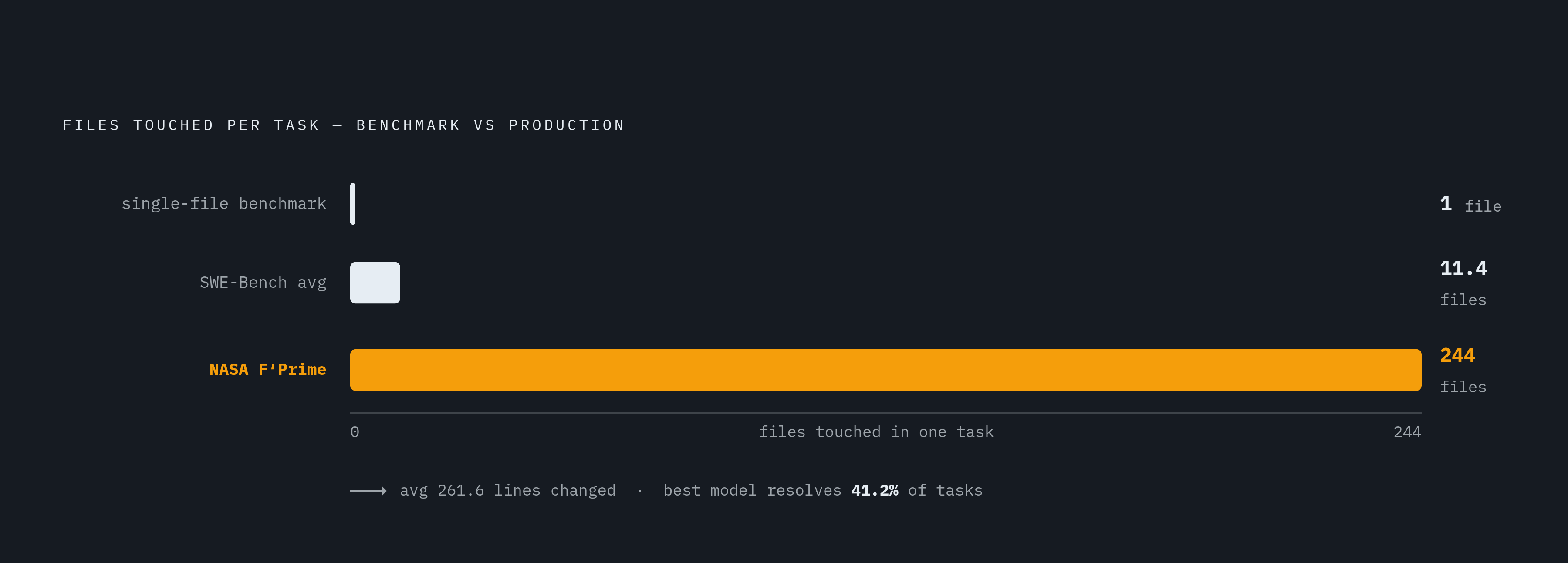
Production refactoring work rarely confines itself to one file; single-file benchmarks give a misleading picture of the difficulty engineering teams face. SWE-Bench ProMax, a multilingual refactoring benchmark built from 170 expert-curated instances drawn from real commits across seven languages, Python, Java, TypeScript, Go, C, C++, and Rust, reports an average of 11.4 modified files and 261.6 lines of code per instance. Its hardest instances go far beyond that average: a refactor drawn from NASA's F′Prime flight software framework touches 244 files in a single task. That scale is not a benchmark curiosity. It describes the actual shape of the work a refactoring agent has to manage once it operates somewhere other than a toy repository.
Refactoring also carries a constraint that bug fixes and feature additions don't share in the same way: every change has to preserve behavior across the entire dependency graph, not just the piece being touched. That constraint multiplies the cost of missing context, because a change that looks locally correct can still violate an invariant elsewhere in the dependency graph. Industry leaders have already adjusted their framing around this reality. OpenAI lists "project-scale refactors" as a primary use case for agents built to sustain work across multiple context windows, and Cursor has reported that real-world developer tasks increasingly span many files and many tools at once, rather than a single function in a single file. The benchmark landscape has followed the same trajectory: evaluation has shifted from function-level tests like HumanEval and MBPP toward repository-level tests like SWE-bench and its successors, a move the profession effectively demanded once it became clear that function-level success told teams little about repository-level reliability.
The context layer: three architectural approaches to navigating large codebases
Context quality has become the main thing separating one agentic refactoring tool from another, and three distinct architectural approaches have emerged to supply that context, each carrying its own strengths, limits, and ways of failing at scale.
The first approach is dynamic context loading through retrieval-augmented generation paired with AST-aware chunking. Instead of loading an entire repository into the context window at once, agents pull code from a pre-built index on demand. Naive retrieval, by contrast, actually performs worse than giving the agent no retrieval at all. Bad retrieval is more dangerous than an agent that admits it has no external context. This approach still runs into a hard ceiling in practice: tools that cap local indexing at a fixed number of files remain unsuitable for large monorepos unless the index is extended with something else.
The second approach builds a real-time knowledge graph instead of a chunked index. Rather than embedding fragments of code as vectors, this method maps dependency paths across services as structured data, capturing relationships between components that vector similarity search tends to miss. One context engine built this way processes large codebases with search latency cut down from over two seconds through quantized vector search optimization, and the resulting speed lets autonomous agents coordinate changes across multiple repositories rather than one at a time. Plugging a context layer of this kind into a base agent via MCP integration produced a substantial improvement in output quality in reported use.
The third approach is deep agentic search through subagent delegation. A planning agent hands off repository exploration to a separate subagent that works inside its own isolated context window and returns only a condensed result, a design meant to prevent context pollution, sometimes called context rot, where accuracy degrades as unrelated material piles up in the main context window. The evidence on this approach is mixed rather than flattering. An empirical study on SWE-QA found that plain semantic search answered a majority of questions correctly, while deep agentic search answered markedly fewer questions correctly and did so at a substantially higher cost per correct answer. The largest share of failures in deep agentic search happened at the handoff between the planning agent and its subagent, and these failures were typically silent: the system returned a fluent, confident answer that was simply wrong. Deep agentic search solves a real problem, context pollution, but it introduces a new failure class in exchange, so teams adopting it need to instrument the handoff explicitly rather than trust the output at face value.
Model Context Protocol now functions as the connective tissue linking agents to whichever of these context layers a team has built or bought. Every leading agent supports MCP at this point, but the depth of that support varies a great deal, and the value an MCP integration delivers scales with the richness of the context layer sitting behind it, not with the protocol alone.
Capabilities and limits of leading agentic refactoring tools
Claude Code, built by Anthropic, runs as an agentic system with a context window large enough to hold tens of thousands of lines of code in one session. It was rated the top AI code refactoring tool in 2026, scoring highest among evaluated tools for both refactoring strength and repository context, and it achieves 80.8% on SWE-bench Verified, the highest reported score for autonomous code modification. Its strengths concentrate around multi-file refactors, long-running tasks, MCP-native tool use, hooks, sub-agents, and a permissions model that teams can actually audit; among leading agents, it carries the deepest MCP integration, including a native registry, full tool-call traces, and durable connection management. In practice, that translates into tasks like migrating a codebase from CommonJS to ES Modules, replacing deprecated APIs across dozens of files, or turning on TypeScript strict mode and resolving every resulting type error, work that would otherwise consume a developer's full day and can instead run unattended. Enterprise and team customers get usage analytics, managed policies, spend controls, a Compliance API, and configurable tool permissions and MCP server settings, with deployment options that include running models inside Amazon Bedrock, Google Cloud's Vertex AI, or Microsoft Foundry. It comes included with Claude Pro.
Cursor positions itself as the market-leading AI-native IDE, built as a full VS Code fork that imports a developer's existing settings, extensions, and keybindings the first time it launches, with no productivity cliff to climb. Its Agent Mode, formerly called Composer, lets a developer describe a change in plain language; Cursor then reads the relevant files, builds a plan, applies changes across the codebase, and surfaces a file-by-file diff for review before anything is committed. Cloud Agents extend this further, running in isolated VMs with parallel sub-agents handling discrete pieces of a task at the same time. Teams can encode project conventions in a.cursorrules file so agent output matches existing code style. Cursor reached multi-billion-dollar annual recurring revenue in early 2026, and tens of thousands of enterprises now use the platform. It fits teams that want multi-file refactoring paired with visual review, and want one tool to handle both generation and cleanup. Pricing runs free at a limited tier, with a Pro tier available for heavier use.
On timed benchmarks, Cursor handles complex multi-file edits faster than GitHub Copilot, though Copilot scores higher on accuracy benchmarks such as SWE-Bench Verified. GitHub Copilot works natively across VS Code, JetBrains, Visual Studio, Neovim, Eclipse, Xcode, and GitHub.com, so teams never have to switch editors to use it. Its Agent Mode reached general availability in March 2026 and now handles multi-file refactoring with results comparable to Cursor for most real-world tasks. Its standout differentiator is GitHub integration itself: referencing an issue inside a refactoring chat connects the bug description directly to the affected code and proposes a targeted fix, which makes Copilot the strongest option for teams that already track work through GitHub Issues and pull requests. It fits teams already on GitHub and teams running mixed-editor environments, and it's priced free with limited completions per month, with a Pro tier available.
Windsurf, now owned by the Cognition/Devin team, is the closest competitor to Cursor within the agentic IDE category. Its Cascade agent handles multi-file refactoring through the same describe-plan-apply-test workflow, and the company released its SWE-1.6 model in April 2026. It suits teams looking for a Cursor alternative with a more generous free tier.
A separate class of tool bets on building a code graph rather than an IDE experience. One platform built specifically for very large codebases constructs a real-time knowledge graph rather than relying on vector embeddings alone, and pairs its refactoring agent with a dedicated code review agent. Another, built on a semantic code graph for cross-repository understanding, shipped a desktop app on September 4, 2026, after spinning off into a separate company in December 2025.
Self-hosted and open-source options deserve consideration as first-class choices, not fallback options for teams that simply can't afford a commercial product. For organizations that cannot send proprietary code to a cloud provider, the OpenHands framework paired with the CodeAct v3 scaffold, released under an MIT license and run inside isolated containers, reached a competitive score on SWE-bench Verified in 2026 when paired with Claude Opus 4.6, close to what proprietary scaffolds achieve. Aider offers a git-native workflow under an Apache 2.0 license. Continue, likewise Apache 2.0, supports Ollama for fully local inference. Any of these four can be paired with a self-hosted context layer, which lets an organization keep the entire retrieval-to-generation loop inside its own infrastructure rather than routing code through a third party.
Common breakdown points in large refactoring tasks
Even the best-performing agents available today fail in predictable, well-documented ways once refactoring tasks grow large, and those failure patterns show that workflow design matters as much as which tool a team picks.
Benchmark scores tend to overstate what these agents can do in production. On SWE-Bench ProMax's expert-curated, large-scale refactoring tasks, the best-performing model achieves only a 41.2% resolve rate, a meaningful drop from the scores the same models post on simpler benchmarks. Part of that gap in simpler benchmarks is itself suspect: a recent audit found that a large share of unsolved SWE-bench Verified instances contain flawed tests, either too narrow to accept correct solutions or too broad to check what was actually asked, and that frontier models can reproduce gold patches verbatim from their training data rather than solving the task fresh.
Agents also tend to succeed only when told precisely what to refactor, and struggle to identify what needs refactoring on their own. Research from CodeTaste shows agents perform well when a refactoring is specified in detail, but often fail to discover the refactoring choices a human engineer would make when given nothing more than a general focus area, the gap between following instructions and exercising independent engineering judgment.
Quality also tends to erode across iterations rather than hold steady. Findings from SlopCodeBench, cited in the same CodeTaste research, show that agent-generated code grows longer and more structurally strained as requirements change over time, so a clean first-pass refactor offers no guarantee that the codebase stays extensible through the iterations that follow. Two concrete experiments illustrate the pattern. An effort to build a web browser using autonomous coding agents made real early progress, then stalled entirely, unable to keep extending a codebase the agents themselves had produced. A separate experiment produced a working C compiler capable of compiling the Linux kernel, but the resulting code was rigid and lacked the kind of abstraction a human engineer would have built in from the start. Both outcomes show that the architecture of the context layer shapes what an agent can see, while sustaining a codebase across time still depends on how the workflow around that agent is designed.
Sources
- AI Code Refactoring Tools in 2026: A Practical Developer's Guide - DEV Community
- SWE-Bench ProMax: Benchmarking Agents on Large-Scale Multilingual Code Refactoring
- CodeTaste: Can LLMs Generate Human-Level Code Refactorings?
- RefactorPlatform: An Open-Source Harness for Controlled Evaluation of Repository-Scale Refactoring Agents
- Deep Agentic Search for Repository-Level Code Question Answering: An Empirical Study
- Best AI Code Refactoring Tools in 2026: Claude Code vs Cursor vs Windsurf