Cross-Repository Search as the Missing Layer in Engineering Onboarding
New engineers need to query the entire codebase to onboard efficiently.

Engineering onboarding fails most often for a structural reason: new hires can't get answers to cross-repository questions, and no single-repo tool, no matter how polished, can supply them. The fix is a layer of code search built to span the entire codebase, available to humans and AI agents alike.
Why new engineers stay stuck
Day one in a multi-repo codebase looks the same at most companies now: a new hire opens a service, finds a function call that reaches outside the repo, and has no way to trace where it goes. The questions that actually block someone in week one are rarely about syntax or local logic. They're about how a service connects to the rest of the system, what else calls a given function, where a field gets used three services downstream. These are cross-repository questions by nature, and no IDE, no single-repo semantic index, and no Confluence page answers them. The only path that works today is asking a senior engineer who happens to carry that context in their head.
This is well illustrated by the case of a shared utility function living in one repository and getting consumed by a dozen others: run a text search for it and the results are mostly noise, so developers default to the person who already knows the answer. Most onboarding portals provide no such retrieval mechanism. They assume the reader already knows what question to ask and where to look, which is precisely the thing a new hire doesn't yet have. The move toward microservices and distributed systems has made this worse by design: the knowledge a new hire needs to function is now spread across dozens of repositories, each with its own boundary, its own owners, and its own blind spots for anyone standing outside it.
What makes cross-repository questions structurally unanswerable with single-repo tools
Single-repo tools fail cross-repository questions because they're built around a boundary, the repository itself, that a cross-repository question crosses by definition. A text search engine matches strings of characters. It can't tell a real call site from a comment, a live function from dead code sitting in an unused branch, or a genuine reference from a string that happens to match by coincidence. That signal-to-noise problem gets worse as the codebase grows, not better.
Cross-repository symbol search works differently: it operates at the level of the abstract syntax tree and resolves identifiers structurally. IDE-based language servers understand the current project and sometimes its declared dependencies, but they stop at the edge of what's checked out locally. They don't index the downstream consumers of a shared package, which is the exact relationship a new hire needs to understand blast radius, or to figure out who owns a piece of logic before they touch it.
The gap between text search and symbol-aware search decides whether a result can actually be acted on. Bigger context windows won't dissolve this problem. Feeding raw files from dozens of repositories into a model is expensive, slow, and lossy, and the model ends up guessing at relevance, often wrongly, because nobody handed it the structure.
The hidden productivity tax that lands on senior engineers
The new hire isn't who pays the real cost of cross-repository ignorance. Senior engineers pay it, because they become the fallback retrieval system for the entire codebase. When a new engineer can't find a cross-repository answer on their own, the only available substitute is interrupting the person with the most context, who is usually also the person with the least spare time.
Context switching makes this worse than it first appears. The tax doesn't stop at engineers, either. Product managers, support staff, and tech leads moving between teams run into the same wall: without a way to query the codebase directly, any architecture or dependency question turns into a ticket or a Slack message aimed at engineering.
Harness frames this as a "context crisis," and the framing holds for human onboarding just as well as it does for AI agents. The bottleneck is the absence of a precomputed, semantically rich, always-available picture of the entire codebase that anyone, human or model, can query directly. Treated this way, cross-repo search stops looking like a developer-experience nicety and starts looking like infrastructure, because the cost it removes falls on the most expensive people on the team. What that infrastructure has to do is the next question.
What cross-repository search does that single-repo tools cannot
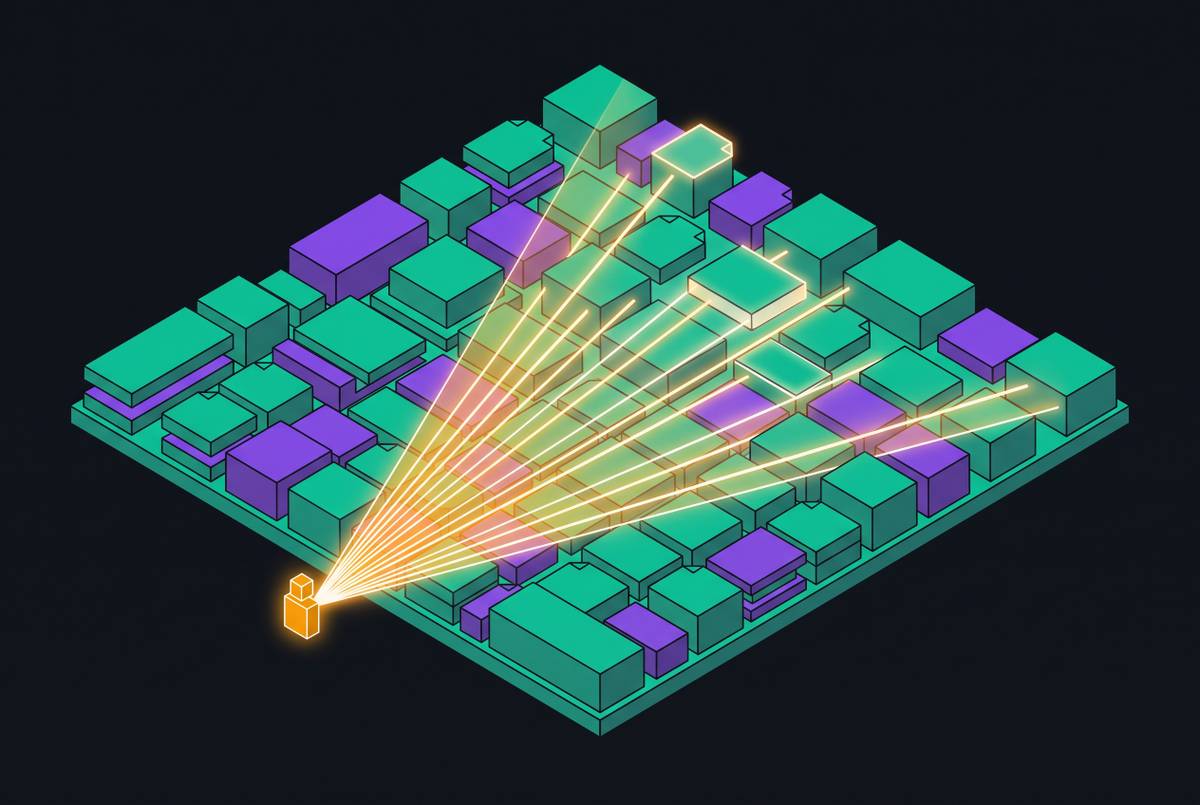
Cross-repository search changes codebase navigation from an exploratory, labor-heavy process into a structured query against a unified index that understands the whole software estate semantically. A query like "find every caller of getUserById" resolves against the real dependency graph across every repository at once, returning a set of semantic relationships rather than a list of string hits that happen to match.
For a new hire, this changes the timeline directly: architecture comprehension that used to take weeks of exploratory reading and senior-engineer Q&A can happen through direct queries answered in hours. For engineering teams more broadly, it changes how debugging, refactoring, and API migration get done. Harness's model pushes this further still: repositories become queryable knowledge graphs, where an agent or a developer can ask what modules depend on what, which functions carry the most risk, and what the design philosophy behind a given component actually is, not just where a string of text happens to show up.
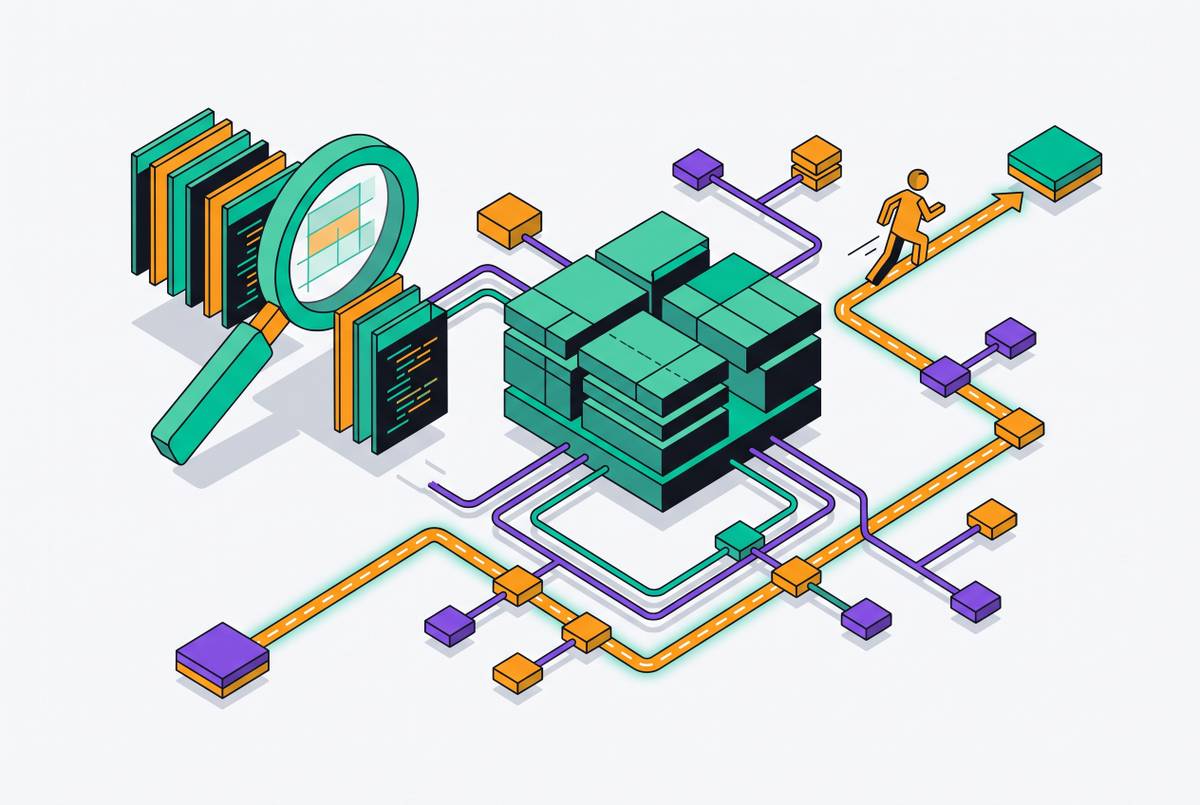
A clean division of labor falls out of this. Static analysis discovers the structural relationships across the whole estate. The index serves those relationships instantly on request. AI reasons over what the index returns to answer natural-language questions. Each layer does only the job it's built for, and none of them tries to substitute for the others. Even comprehensive documentation is close to useless without a way to query the codebase when you don't yet know what you're looking for. A cross-repository code intelligence layer, whether built in-house or adopted through a platform like Sourcebot, turns a distributed codebase into something a new hire can interrogate directly, without pulling a senior engineer away from their own work. Given that this capability exists, the next question for anyone evaluating tools is which ones actually deliver it, and under what constraints.
Evaluating cross-repository search tools for enterprise onboarding
Search quality alone doesn't settle which tool belongs in an enterprise onboarding stack. Where the code gets indexed, who can see the results, and whether the tool works for people who aren't developers matter just as much. The first question is depth: does the tool resolve symbols across repository boundaries, or does it stop at the package or project level? A tool that indexes several repos as separate silos hasn't solved cross-repo dependency resolution at all, it has just made several single-repo searches faster. The second is the onboarding interface itself: can a new hire, or a PM with no engineering background, ask a plain-language question and get a grounded answer without already knowing how the codebase is organized? Comprehension of a codebase someone has never seen before matters just as much as how deep the index goes, especially in the first week.
The deployment model deserves more scrutiny than any other single factor, because it sets the ceiling on everything else a buyer might want. The real evaluation question for enterprise AI coding tools is whether code ever leaves the network, whether anything gets retained or trained on, and whether processing can be pinned to a specific environment, be it SaaS, self-hosted, VPC, or air-gapped. From there, the evaluation should check AI agent integration: as teams adopt coding agents, the same index serving human onboarding ought to also serve agent context, through MCP or an equivalent protocol, so the investment pays for two use cases. Finally, bring-your-own-model flexibility lets a team choose its own LLM provider and keep control over where code is sent, rather than getting locked into a vendor's hosted model with no visibility into how data gets handled on the other end.
Cross-repository search tools worth considering for engineering teams
Tools that deliver real cross-repository search for enterprise onboarding differ quite a bit in deployment model, privacy posture, and how well they serve non-engineers alongside developers.
Sourcebot deploys as a Docker Compose stack, running its own container alongside Postgres and Redis containers, inside the customer's own infrastructure. Source code, developer prompts, and generated responses never leave the network boundary, which tends to let it clear enterprise security review faster than SaaS-hosted alternatives. It indexes every repository across an organization and serves engineers, PMs, support staff, and new hires through the same natural-language interface that also serves AI coding agents, closing the non-engineer access gap that most code search tools simply ignore. Because that same MCP integration provides full codebase context to AI coding agents running in Cursor, Claude Code, or similar environments, the infrastructure pays off twice: once for onboarding, once for agent output quality. Teams choose their own LLM provider rather than accepting a vendor's hosted model with opaque data handling, and the free tier indexes real repositories, letting a team prove out value before anyone has to sign off on a purchase.
GitHub Code Search supports cross-repository search across every repository in an organization at once, with regex, symbol search, path filters, and code navigation that includes jump-to-definition and find-all-references within a single repository, though not across repository boundaries. Because it's built into GitHub, teams already there get the capability without a separate deployment, and self-hosting options exist for private codebases. It fits best for teams whose entire estate already lives in GitHub and who are comfortable with GitHub's data handling; it fits less well in mixed-host environments or for teams under strict data-residency requirements.
Repowise frames its core question as where a given behavior lives, who owns it, and what depends on it instead of where a string of text shows up, which lines up closely with the cross-repository onboarding challenge. It's built for teams that want to evaluate code by behavior and ownership.
Aider's tree-sitter repo map extracts the key symbols in a project and ranks them by how often they're referenced before sending a condensed map to the model, free and open source under Apache 2.0. It works on one repository at a time for edits, though read-only files from other repos can get pulled in via /read, which is the exact limitation this piece has been describing. It's a strong complement for deep work inside a single repository, not a substitute for search across an entire organization's repos.
Cross-repository search as the AI agent context layer
The same cross-repository index that speeds up human onboarding doubles as the context layer AI coding agents need to avoid hallucinated APIs and architectural regressions, which makes it infrastructure. Harness's analysis of the agentic software development lifecycle shows the failure mode clearly: without a cross-repo context engine, a coding agent asked to implement rate limiting writes an inline solution that ignores the existing middleware pattern, the shared interface, and the observability integration already in place. The code compiles, but it's wrong in every way that matters to the team that has to maintain it afterward.
Give that same agent a context engine; the sequence changes. The resulting PR passes review on the first pass. The division of labor is the same one described earlier: static analysis discovers the structural relationships, the index serves them, and AI reasons over what gets served, each layer doing only its own job, now applied across the full software estate. MCP is what delivers this in practice. The distinction matters because it decides whether a search result is something an agent can act on at all: a text search for a common field name across a large enterprise system might return tens of thousands of hits, while symbol search narrows that down to the specific data element and its actual usage across the dependency graph. This is what an agent context layer like Sourcebot provides, structural understanding of how code relates across the whole codebase, not string matching confined to one repository. For an engineering leader weighing this investment, the onboarding payoff is visible almost immediately, while the agent-context payoff scales with however many AI-assisted development tasks the team runs, and both draw from the same underlying index.
Checklist for cross-repository search in an onboarding stack
Cross-repository search works best when it's treated as shared infrastructure for both human and agent users, not as one more tool bolted onto an existing single-repo workflow. Deployment model deserves evaluation before any feature list does, because a tool that sends code to a third-party SaaS for indexing may never clear security review for codebases holding regulated data or proprietary IP, so that question needs an answer first. Non-engineer access belongs in the requirements from the start: a cross-repo search layer that assumes IDE setup shuts out PMs, support staff, and new hires who aren't yet comfortable navigating the codebase, and the natural-language interface matters as much as how deep the index actually goes. Confirming that the same index serves AI coding agent context as well as human queries, through MCP or an equivalent protocol, keeps the organization from standing up a second, duplicate deployment later when agentic workflows expand. A free tier that indexes real repositories ahead of any purchase decision lowers the risk of adoption, letting a team show the drop in interrupts and the gain in time-to-contribution before committing budget.
Cross-repository search is working when senior engineers spend measurably less time fielding architecture questions, new hires reach their first meaningful contribution faster, and AI coding agents turn in PRs that fit the team's existing patterns on the first pass.