Docker-Native Developer Tools for Codebase Intelligence
Containerized deployment and standardized protocols reshape how AI agents access private codebases.
Docker-native deployment is not a footnote in how AI codebase intelligence tools get shipped. It decides whether the tool ever makes it past security review at a company that will not let its source code leave the building. As AI coding agents move from optional extra to daily infrastructure, the runtime a tool depends on matters as much as what the tool actually does. Most vendors still treat deployment architecture as packaging, something to bolt on once the product works. That's the wrong order of operations, and enterprise buyers are the ones catching it.
The trajectory looks familiar to anyone who watched Git, and Docker itself, go from developer preference to organizational default. AI coding tools have already made that same climb inside most large engineering organizations, and the underlying cause is that the tooling underneath them now has to hold up under audit conditions, not demo conditions, because enterprise adoption forces scrutiny that demos never faced.
What "Docker-native" means for a developer tool, and why the label matters
Plenty of tools "ship a Docker image." Fewer are actually Docker-native, and the difference sounds pedantic right up until someone tries to deploy one of each inside a regulated environment. Then it's the whole ballgame.
Shipping a Docker image usually means someone took an installation process built for a specific OS, a specific set of system packages, maybe a background service or two, and wrapped it in a container after the fact. It works, mostly, the way a translated document works: the meaning survives, the seams show. Docker-native means the container was the design target from the start. The image is the runtime, not a wrapper around it. It is the runtime.
That distinction appears in concrete places. A single image carries the runtime, every dependency, and startup configuration together, so a laptop, a build server, and a cloud instance all behave the same way, and "works on my machine" stops being an excuse anyone gets to make. Deployment becomes a docker run or a docker compose up, instead of a checklist of installation steps that drift out of sync across a team within a few months. State (indexes, caches, agent configuration) lives in mounted volumes rather than baked into the image, so a restart doesn't erase a day's worth of indexing work.
For a general web app, that's convenience. For a codebase intelligence tool, it's closer to a requirement. These tools sit inside a company's network perimeter because they read private repositories that no external cloud service gets to touch. They're also long-running services, not short request-and-response endpoints: they hold an index, they answer repeated queries against it, and containerization fits that operational profile far more cleanly than infrastructure built for stateless web traffic ever could.
None of this rests on Docker being untested. Docker has run in production for over a decade. Docker-native is a proven architecture, applied to a newer category of problem.
The operational mismatch between AI agent workloads and the runtimes most tools assume
Most modern cloud infrastructure was built around one assumption: requests are fast. A typical web request completes in milliseconds. Agent workloads break that assumption completely, and a platform designed around the millisecond case is the wrong foundation for them, full stop.
An agent pipeline that retrieves codebase context, runs verification steps against that context, and then generates output can easily take two to five minutes end to end. Serverless platforms impose strict execution time limits precisely because they're optimized for the millisecond case, and they choke on that shape of workload. Managed container platforms don't share the problem. They handle long-running requests with configurable timeouts, because containers were built to support exactly that kind of workload.
Indexing makes the mismatch worse. Building and holding a codebase index is resource-intensive and, more to the point, stateful. A container can keep that index alive on a mounted volume between requests. A serverless function, by design, cannot: it spins up, does its job, and disappears, taking any in-memory state with it. Rebuilding an index from scratch on every invocation isn't a minor inefficiency. At the scale enterprise codebases operate at, it's a nonstarter.
Developers already lose a large share of the working day to context-switching and environment friction rather than to writing code itself. A tool that fails to start reliably, or that loses its state between sessions, adds directly to that drag. A containerized tool that starts the same way every time, and holds its state between runs, removes one more source of the friction eating the rest of the day.
How MCP Turned the Context Problem into a Standard Protocol
Before the Model Context Protocol existed, connecting an AI assistant to GitHub, to Jira, to an internal database, and to a codebase meant building a separate custom integration for every pairing. Every new client needed its own connector to every tool it wanted to use. That's an N×M problem, and it scales badly: five clients and five tools means twenty-five potential integrations, each maintained separately, each breaking separately, usually at the worst possible time.
MCP's contribution is simple to state, even if it took real engineering to pull off: write a server once, and every compatible client can consume it. N×M collapses to N+M. A team builds one codebase intelligence server, and it works with any client that speaks the protocol, instead of needing a bespoke integration per agent.
Anthropic introduced MCP in November 2024, and it didn't stay a single-vendor project for long. In December 2025, the protocol moved to the Agentic AI Foundation under the Linux Foundation, putting its governance on genuinely vendor-neutral footing instead of leaving it tied to the company that invented it. That mattered for adoption. Claude Code, Cursor, VS Code Copilot, Codex, Windsurf, Zed, Continue.dev, Cline, and Goose all carry MCP support now. OpenAI adopted the protocol in March 2025, Google DeepMind followed, and major agent frameworks moved to adopt MCP for tool-calling. When that many independent players converge on the same protocol without being forced to, the convergence says something: enterprises had a shared integration problem, and MCP happened to be the thing built to solve it.
What codebase-specific MCP servers provide that generic file-search does not
Most public conversation about MCP centers on databases, CRMs, and communication tools, connecting an agent to a team chat tool or a CRM or a database instance. That coverage undersells the protocol's more consequential job, which is delivering codebase context to an agent that has to reason about a system it didn't write.
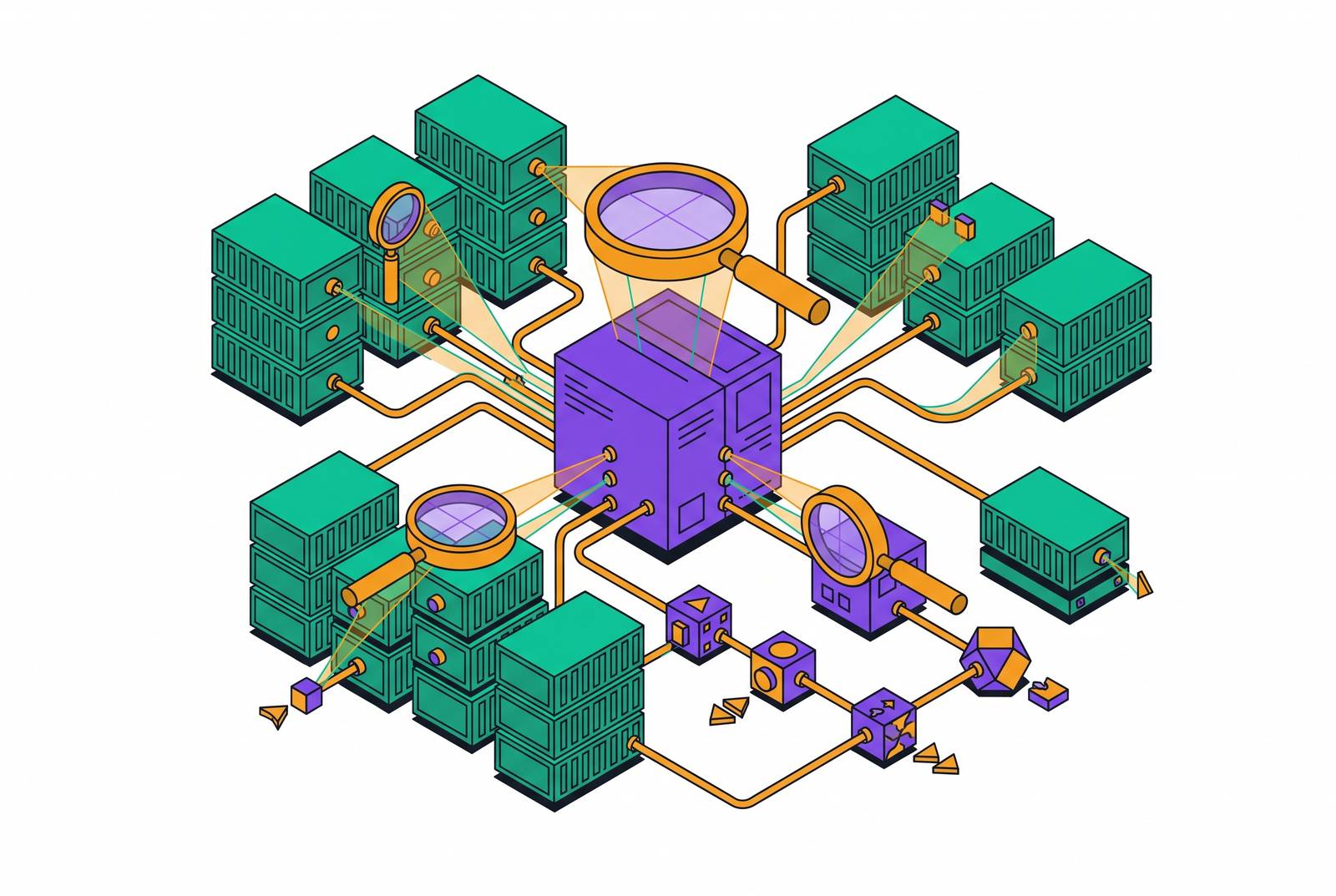
Codebase MCP capability roughly sorts into three tiers, and conflating them is where most of the confusion in this space starts. File-search servers help an agent find files by name or path, useful, and also close to what a shell find command already does. Semantic-search servers go further, helping an agent locate relevant code by meaning rather than filename, closer to what embedding-based search tools have offered for a few years now. Code-intelligence servers belong to a different category. They help an agent understand an entire system: its architecture, its business rules, its dependencies, the blast radius of a proposed change, through one standardized connection instead of a pile of ad hoc queries.
repowise, a code-intelligence MCP server, shows what that third tier looks like in practice: ten distinct tools, including get_overview, get_context, get_symbol, search_codebase, get_why, get_risk, get_change_risk for pre-merge defect scoring, get_health, get_dead_code, and get_answer. That's a different offering than "search for this string." It's a structured interface for the questions an engineer actually asks when evaluating a change: where a thing lives, why it exists, what depends on it, how risky it is to touch.
The gap shows most clearly at scale. Picture an engineering team facing half a million source files spread across dozens of repositories, needing to trace a single payment flow as it threads through a Java monolith, three separate Go microservices, and a React storefront. A tool that only sees whatever file is currently open in the editor cannot answer that question, structurally, no matter how it's prompted. Cross-repo reasoning needs a different kind of server. It isn't a feature bolted onto file search after the fact, it's a different architecture from the ground up.
Security guarantees that Docker-native deployment provides for code that cannot leave the building
The security stakes here aren't hypothetical, and the industry has the scar tissue to prove it. Among enterprises that have deployed AI coding assistants, more than a third have already experienced a security incident tied to those tools. That figure belongs at the center of any deployment-model evaluation. It isn't a worst-case scenario raised once a year in a risk committee meeting, it's a documented outcome that's already happened at a meaningful fraction of the companies running this software.
Much of that risk traces back to tools that build their understanding of a codebase by sending that codebase to an external service: proprietary algorithms, business logic, and often credentials that got carelessly embedded in configuration files somewhere along the way. Once that data crosses the network boundary, the organization's ability to control what happens to it drops sharply, and no amount of vendor assurance fully restores it.
Docker-native deployment inverts that model. The index gets built and held entirely inside the organization's own infrastructure, and no code ever transits an external network boundary to get there. For a legal team or a security review board deciding whether to approve a tool, that difference often separates an easy yes from a months-long negotiation, if not an outright no.
The Docker MCP Gateway adds another layer on top of that arrangement. It sits as a secure intermediary between AI agents and internal tools, so agents never receive raw API credentials directly: access gets scoped, and tool interactions get logged. Running MCP inside a containerized environment like this has moved from an architectural detail to a standard line item on enterprise AI deployment checklists, the kind of thing a security team now asks about by default instead of something a vendor has to explain from scratch.
How Major AI Coding Agents Connect to a Docker-Native Context Layer
Claude Code, Anthropic's CLI-based autonomous agent, runs in the terminal and operates directly on the codebase rather than through a chat window. It uses MCP servers to handle filesystem access, Git operations, and terminal execution, which lets it navigate a codebase, make edits, and run tests without a developer manually copying code back and forth. With a context window over 200,000 tokens, it's become a common choice for terminal-first agentic coding in on-prem and enterprise evaluation settings, and it connects to a locally running MCP server over the standard protocol, one that can just as easily be a Docker container on the same host or the same internal network.
Cursor, an AI-native IDE built on top of VS Code, centers on Agent Mode, paired with Composer for multi-file edits, as its defining feature. It advertises a 200,000-token context window, though real-world use tends to land closer to 70,000 to 120,000 tokens in practice, a gap that matters once a codebase gets large. MCP support lets Cursor hand off structured codebase queries to a running code intelligence server instead of burning through that context window dumping raw file contents into the prompt.
GitHub Copilot remains the most widely adopted tool in the category. Its agent mode reads an entire codebase, plans changes across multiple files, runs terminal commands, and iterates until tests pass. Copilot's billing model has shifted toward usage-based pricing, which makes cost variability beyond the base seat price something enterprise budget planners now have to account for directly rather than treat as a rounding error. MCP support means Copilot's agent mode can point at a self-hosted code intelligence server instead of depending solely on GitHub's own indexing.
JetBrains Air, currently in public preview for macOS, was built on the codebase of the discontinued Fleet IDE. It orchestrates multiple agents at once, including OpenAI Codex, Claude Agent, Gemini CLI, and JetBrains' own Junie, running them concurrently in sessions that can be isolated locally, in a Git worktree, or inside Docker. It communicates through the open Agent Client Protocol for vendor-neutral agent coordination, alongside MCP support. A standalone companion, Junie CLI, is a bring-your-own-key coding agent that's LLM-agnostic, with one-click migration paths from both Claude Code and Codex.
Context Limits That Large Codebases Expose
At small scale, a context window feels generous. A handful of files, one service, a contained problem: an agent can hold all of it in view at once and reason about it without strain. That comfort disappears the moment a codebase spans hundreds of thousands of files across dozens of repositories, which is the operating environment some enterprise-scale tooling is explicitly built around.
At that scale, an agent that only sees the current file is structurally incapable of reasoning about the dependencies that actually matter, and no clever prompt fixes that. Changing a payment flow that threads through a Java monolith, three Go microservices, and a React storefront requires holding the entire dependency graph in view at once. That's an architectural gap.
A blunter constraint drives the whole thing: tokens run out. Without a semantic code intelligence layer standing between the agent and the raw repository, the agent has no choice but to dump file contents directly into its context window just to get some grounding. That approach is expensive, it's slow, and on a codebase of real enterprise size, it stays incomplete no matter how much gets stuffed in.
Swapping the raw dump for structured MCP queries, ones that return a targeted answer instead of a wall of source code, causes token costs to fall by something close to an order of magnitude. That's the line that actually separates a tool built for enterprise scale from one that only ever worked in the demo: not the model behind it, not the interface, but whether it answers a targeted question or hands back the whole file and calls it context.