Code Search ROI for Engineering Organizations
AI coding tools only deliver ROI when engineering teams can search their entire codebase.
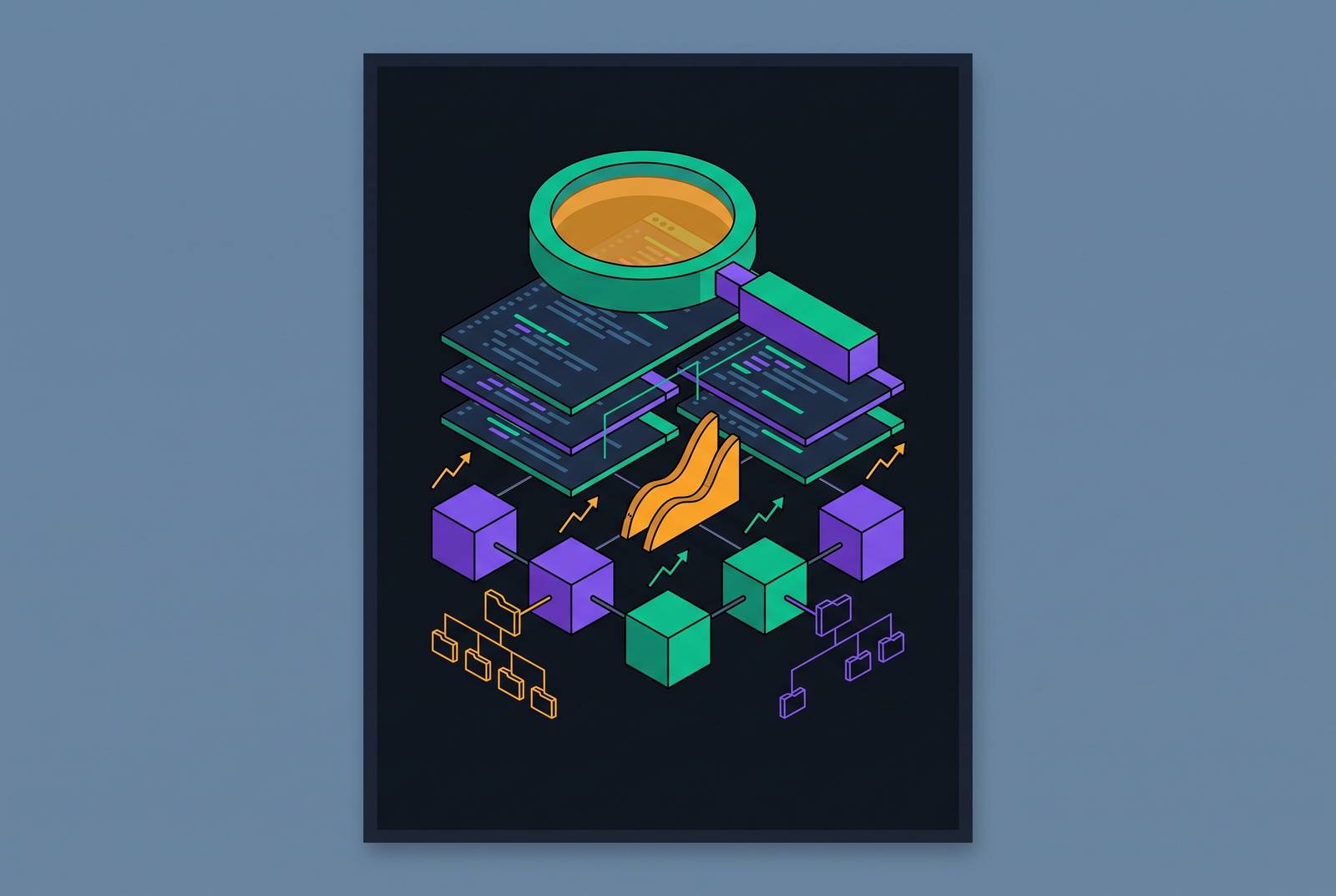
Code search ROI is a real, measurable thing now, not a vibe. Companies that treat code understanding as plumbing (boring, load-bearing, invisible when it works) get compounding returns from every AI coding tool they buy. Companies that treat it as a nice-to-have watch those same tools generate more code and more mess in roughly equal measure.
The Stack Overflow Developer Survey put AI tool adoption or planned adoption at 84% of developers in 2025, up from 76% the year before. Nobody's debating whether to use these tools anymore. Meanwhile, a significant share of companies pulled the plug on most of their AI initiatives, and the average org threw out a large portion of its AI proof-of-concepts before they ever reached production. Only about a quarter of companies say they can even get a project past the pilot stage.
That gap, high adoption paired with high abandonment, is a symptom of something else entirely. It's a measurement problem stacked on top of an infrastructure problem. Most ROI math treats AI coding tools like a nice espresso machine bolted onto an existing kitchen. The orgs actually seeing returns compound over time treat code understanding as the plumbing itself, the thing everything else runs through.
What productivity gains from AI coding tools actually look like when measured rigorously
Vendor numbers are optimistic by design. GitHub has cited a 55% productivity gain from Copilot, and that number gets repeated in board decks constantly. Controlled research tells a more grounded story.
Google ran a randomized controlled trial with a group of engineers doing a realistic enterprise coding assignment. The group using AI finished in about 96 minutes versus 114 for the control group, a gain of roughly 21%. Other controlled studies in enterprise settings land in a similar range, somewhere around 20 to 30% faster when the tools are set up properly.
Then comes the wrinkle. METR ran a randomized controlled trial on experienced developers working in mature codebases, and those developers actually took 19% longer with AI tools turned on. The absence of a typo or contradiction here makes sense once you think about what's different. Those developers already carried the codebase in their heads. There was no context to reconstruct, so the AI tool became overhead instead of a shortcut.
That comparison tells the whole story. The 21% gain shows up when context has to be rebuilt from scratch, which describes most enterprise engineering work most of the time. Nobody joins a 400-repo codebase with the whole dependency graph memorized. Jellyfish, looking across more than 500 engineering organizations, found average cycle time improvements around 25% and PR throughput gains around 12%, numbers that sit closer to the Google study than the METR one.
Individual output and company output are not the same thing, and mixing them up is where a lot of ROI math goes sideways. Vendors commonly report 20 to 40% gains in individual output. That speed rarely turns into faster company-wide delivery unless review processes, CI/CD, and QA get rebuilt to handle the new pace. Even a modest throughput bump across a large engineering team can translate into meaningful output gains equivalent to additional headcount, without the extra salaries, desks, or onboarding headaches. But only if the org actually captures it instead of just generating more code that sits in a review queue.
Whether the developer typed faster was never the right question." It's whether cycle time dropped, deployment frequency went up, and code turnover stayed sane.
The hidden cost base that most ROI calculations miss entirely
Nobody's buying a $30 seat license anymore, and pretending otherwise is how ROI spreadsheets end up embarrassing. Agentic tools like Claude Code can run anywhere from $200 to $2,000 or more per engineer per month in token spend alone, with total AI tooling costs landing somewhere between $200 and $600 a month per engineer on average. That's a real budget line, not a rounding error.
Gross productivity savings need to get discounted, too, typically by something like a 60% utilization factor once rework from machine-generated code churn gets factored in. And there's a cost that never shows up on a dashboard: the navigation tax. Engineers working in large, fragmented codebases spend a big chunk of their day not writing code, but hunting for it, tracing where an API gets called, figuring out what already exists so they don't rebuild it badly. None of that shows up in PRs merged or lines of code. It shows up as drag on cycle time, and it lands hardest on senior engineers, who become the de facto search engine for everyone else.
There's a quality wrinkle worth sitting with. A growing share of merged code is now AI-authored, and research indicates AI-coauthored pull requests tend to carry a higher issue rate than human-only ones. So review burden climbs right alongside adoption. GitClear's data shows code churn rising from a pre-AI baseline of around 3.1 to 3.3% to a noticeably higher rate through 2024 and 2025. More code, produced faster, without any grounding in what already exists, is simply more debt. It's just more code.
Lines of code, raw PR counts, and commit totals actively lie to you in an AI-assisted workflow. DORA metrics and complexity-adjusted throughput are the frameworks that actually surface what's happening underneath the volume.
Why AI coding agents fail at enterprise scale without full codebase context
Call it the big code problem. An org scales from a few dozen repositories to a few thousand, and the AI tool is still only looking at the file open in front of it. It has zero visibility into everything else that already exists.
Tools like Claude Code and Cursor are genuinely good at generating new code inside the project they're currently working in. Outside that window, they're flying blind. They can't answer the questions that actually matter at scale: where does this API get consumed, who's depending on this function you're about to deprecate, does something already solve this exact problem three repos over?
Anthropic's own documentation on Claude Code makes the mechanism explicit. Agentic search, meaning the agent traversing directories, grepping around, following references, only works well when it already has enough context to know roughly where to look. Ask it to hunt for a vague relationship across a massive codebase, and it burns through its available context window before it finds anything useful. That's not something a smarter model fixes next quarter. It's a context architecture problem, full stop, and better reasoning doesn't solve a problem rooted in where the information lives.
The move toward agentic workflows, where the ask shifts from "finish this function" to "handle this ticket, write the tests, do the migration," makes large-scale code search more valuable, not less. And that elevated issue rate on AI-assisted PRs mentioned earlier? Part of that is simply agents writing code with no idea what already exists in the codebase around them. Code search and code generation aren't competing tools. They're a pair, and the return on one depends heavily on whether the other is doing its job.
How MCP standardizes the connection between agents and codebase context
Model Context Protocol, or MCP, is the open standard Anthropic introduced in November 2024. It got handed off to the Agentic AI Foundation, a directed fund under the Linux Foundation, in December 2025.
MCP's job is straightforward: give AI agents a standardized way to connect to outside tools and data. For a software team, the single most valuable thing to connect that way is the codebase itself.
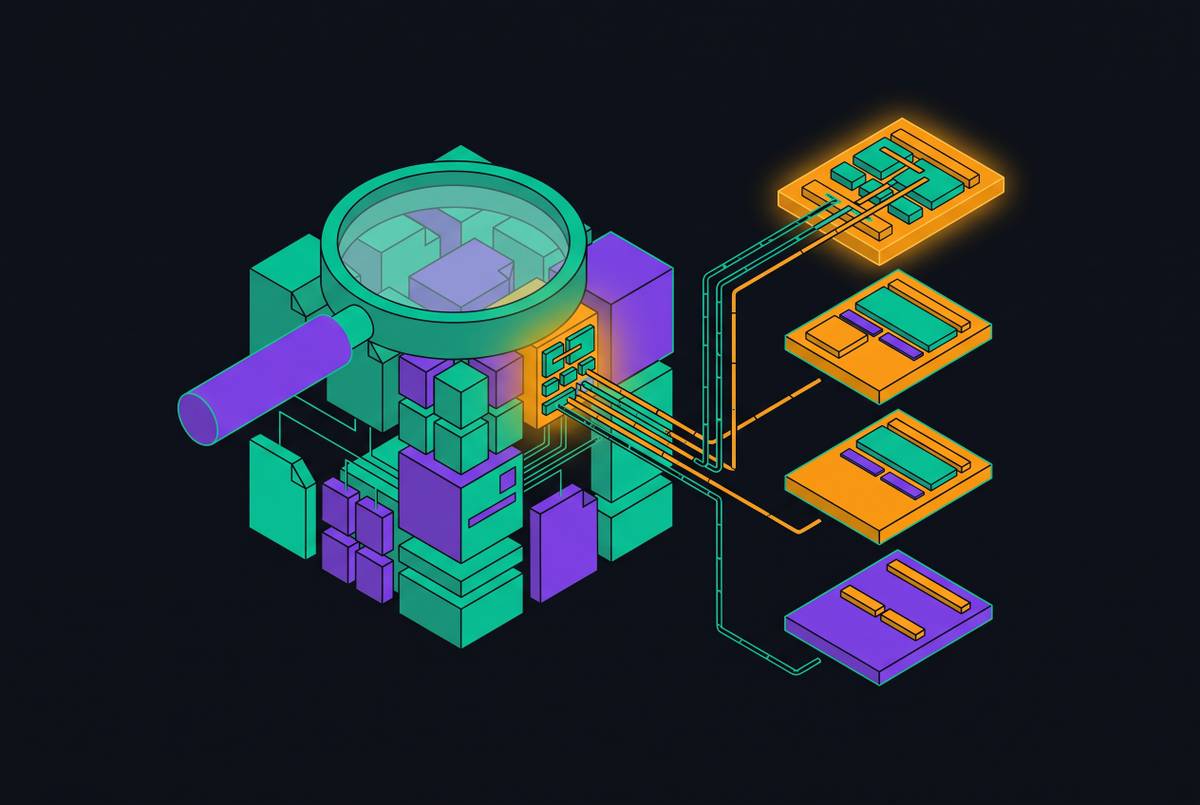
"Codebase MCP server" means very different things depending on who's selling it. At the basic end, it's file search and grep-style retrieval, useful but shallow. A step up gets semantic retrieval from a vector index, better at fuzzy matches. The full version delivers actual code intelligence: services, APIs, callsites, fields, third-party integrations, sensitive dataflows, and cross-reference navigation that lets an agent walk the whole dependency graph instead of guessing.
Anthropic itself points to a whole stack of components needed for Claude Code to work well at enterprise scale: CLAUDE.md files, hooks, skills, plugins, Language Server Protocol integrations, subagents, and MCP servers. That's a lot of moving parts, and it says something about how far the bar has moved past "just plug in the API key."
The architecture taking shape looks like this: generate evidence about the codebase using deterministic static analysis, keep that evidence current as engineers ship changes, then expose it to agents through MCP. The neat part is that same evidence layer doesn't just serve coding agents. It can feed privacy data mapping, AI governance reviews, compliance audits, and security investigations, because it's all the same underlying map of what the code actually does. Context management, permissions, sandboxing, audit logs, and cost controls now matter just as much as model quality. The product question has shifted from "does it complete code well" to "does it fit into how the org actually works."
Self-hosted code intelligence platforms with an MCP server essentially hand every agent the equivalent of a senior engineer's mental map of the whole org's codebase, available on demand, without chewing through the context window to rebuild it from scratch.
The onboarding ROI that compounds across every new hire and team expansion
Onboarding a single $130,000 software engineer typically costs somewhere between $65,000 and $130,000 all in, meaning half to a full year's salary before that person is fully productive. That's a jaw-dropping number until you see where it actually comes from.
It's not recruiting fees or a new laptop. It's the ramp. Most engineers operate well below full capacity for their first several months on the job, simply because they don't know where anything is yet.
And that ramp doesn't happen in isolation. A senior engineer ends up spending a meaningful slice of their own time fielding questions from that new hire instead of shipping their own work. The new hire's annoying manner isn't the culture failure at play here. It's an information architecture failure. New hires ask because there's no faster way to get an answer out of the codebase itself.
Code search fixes the actual bottleneck by making the codebase answer its own questions. A new hire can ask "what does this service do" and get an answer without booking thirty minutes on someone's calendar. Non-engineers, PMs, support staff, people who'd never open a terminal otherwise, can query repos directly in plain language. And the same interface serving humans is exactly what AI agents use when they're working autonomously on a ticket.
Research has flagged onboarding and unfamiliar codebases as some of the highest-ROI scenarios for AI tools specifically, with teams saving substantial time on routine coding tasks once AI handles the standard patterns. And onboarding ROI isn't a one-and-done event. Every new hire, every reorg, every engineer switching from backend to infra triggers the whole ramp-up cost again. Organizations that fix the underlying navigation problem once get to bank that ROI every single time headcount moves.
What self-hosted deployment changes about the privacy and cost calculus
Security reporting from 2025 shows a substantial share of enterprises experienced some kind of AI-related data exposure incident, mostly from weak input controls or fuzzy data handling policies, with code and technical IP among the commonly exposed asset types.
Regulation is stacking on top of that risk, not replacing it. China's PIPL sets its own data localization rules, and India's DPDPA introduces its own data protection framework for companies operating there. The EU AI Act introduces obligations relevant to AI systems, though it stops short of mandating localization outright. For any company operating across a few of these jurisdictions at once, that's a genuinely tangled compliance picture.
Many organizations now have a dedicated AI governance committee on paper, though a much smaller share describe that committee as mature and actually proactive. Governance is playing catch-up to adoption, and it's not close.
Self-hosted deployment sidesteps a chunk of this directly. Code never leaves the company's own infrastructure. Agents query a local index instead of pinging some cloud endpoint sitting outside the firewall. Analyst projections point to near-universal AI coding assistant adoption among enterprise engineers within a few years, and yet plenty of companies right now spend months evaluating whether a cloud tool meets their data residency requirements while running systems with known vulnerabilities in the meantime. That gap is worth sitting with.
Self-hosting isn't only a security argument, either. Bring-your-own-model setups let teams pick their preferred LLM provider instead of getting boxed into one vendor's per-token pricing forever. And single-container deployment (one Docker container, not a fleet of microservices) removes the old objection that self-hosted tools need a dedicated platform team just to keep the lights on. The procurement questions worth asking in 2026 are pretty concrete: can the agent's filesystem and network access get locked down, and can token spend get capped by team or project. Self-hosted setups answer yes to both.
The tools engineering leaders are actually evaluating for enterprise code search
Zoekt is a search engine built in one programming language, released under a permissive open-source license, using trigram indexing for substring and regex search. It's fast, sub-50ms on Android-scale corpora (roughly 2GB of text), with symbol-aware ranking and both a web UI and JSON/gRPC APIs. It's the engine quietly running underneath a lot of code intelligence platforms, with around 1.7 thousand GitHub stars as of mid-2026. It's search-only by design, though: no cross-reference navigation, no "who calls this," no impact analysis, no built-in MCP server. Good fit for teams that want raw speed and plan to build the intelligence layer on top themselves.
Tabnine offers both cloud and self-hosted deployment and learns from a team's own coding patterns to sharpen its suggestions over time. Enterprise plans include custom model training on private codebases and local server deployment that keeps code from leaving the building. It's built primarily for autocomplete and suggestion quality rather than organization-wide navigation, so it fits teams whose main pain point is "make my editor smarter," not "help me find things across 800 repos."
Onyx is open-source and self-hostable, with more than 40 connectors, full APIs, its own MCP server, and support for any LLM a team wants to plug in. Of the open-source options, it's the strongest one for teams that need broad connector coverage alongside actual code search.
Glean wins on connector breadth and polish for large enterprises with the budget to match. It's cloud-first, which makes it a tougher fit for organizations under strict data residency rules.
Beyond the individual tools, a couple of patterns cut across all of them. Native connectors into Jira, Linear, and Confluence, sometimes with MCP tooling layered on top, mean the same infrastructure feeding an AI agent's codebase context can also answer project management questions. A natural-language interface that lets non-engineers query repos directly cuts down the interrupt load on senior engineers who'd otherwise be fielding every "where does this live" question personally. And bring-your-own-model support keeps teams from getting locked into a single LLM provider's roadmap and pricing.
How to build a measurement framework that captures
A measurement framework for code search ROI has to track two things at once: whether engineers are getting faster, and whether the code they're producing is actually holding up. Track only the first, and the numbers look great right up until the rework bill comes due.
Start with cycle time and deployment frequency, the standard DORA metrics, but pair them with complexity-adjusted throughput rather than raw PR counts or lines of code. A PR that touches twelve files across three services and doesn't need a follow-up fix two weeks later is worth more than five one-line commits, even if the commit count looks flashier in a dashboard.
Onboarding ramp time deserves its own line. Track how long it takes a new hire to ship their first meaningful PR without heavy mentor involvement, and track how much time senior engineers actually spend answering codebase questions. If both those numbers are dropping, code search is doing its job.
Token spend and rework rate need to sit next to each other, too, since a tool that's cheap per seat but generates code that needs constant fixing isn't actually cheap. And churn rate, a code-analytics-style metric on how much freshly written code gets rewritten shortly after merging, is one of the clearest early warning signs that machine-generated code is shipping faster than anyone's actually understanding it.
None of these numbers mean much in isolation. Together, they tell you whether the org is compounding its returns on AI tooling or just generating a bigger pile of code to review later.
Sources
- The ROI of AI in Coding Development: What Teams Need to Know in 2025 | by Riccardo Tartaglia | Medium
- The cost of implementing AI in engineering: why ROI is lower than expected and how to measure it accurately
- Best of 2025: AI in Software Development: Productivity at the Cost of Code Quality? - DevOps.com
- Measuring the Impact of Early-2025 AI on Experienced Open-Source Developer Productivity
- metr.org
- en.wikipedia.org
- onyx.app
- getdx.com